
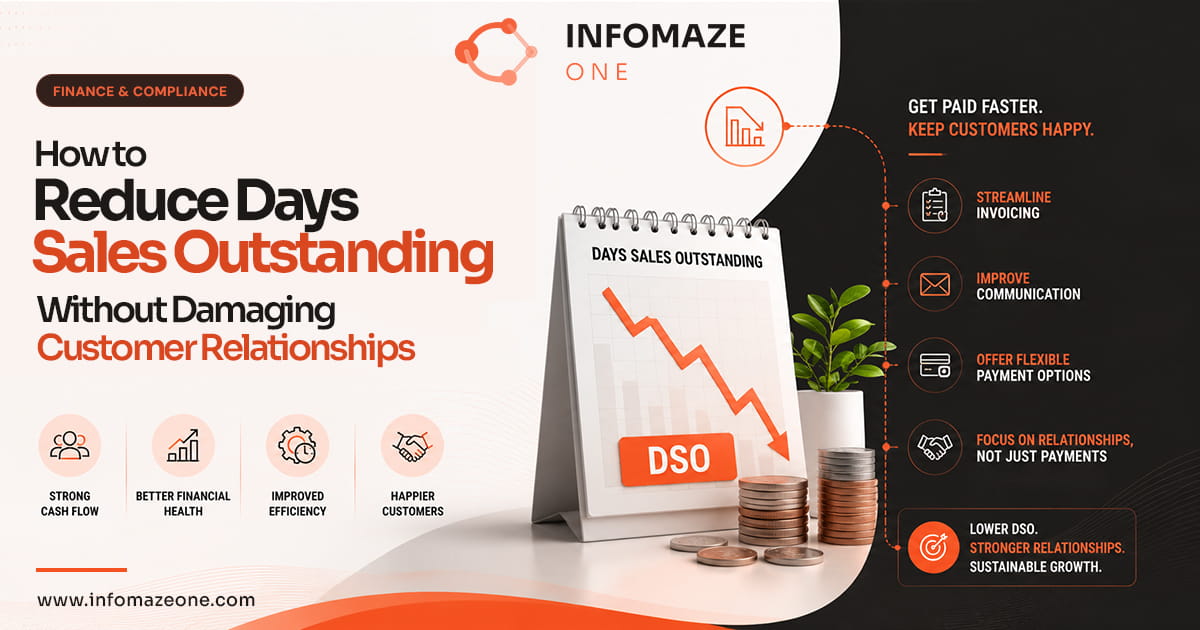
The DSO Dilemma
Every finance director wants to reduce Days Sales Outstanding. Getting paid faster improves cash flow, reduces the need for credit facilities and decreases the risk of bad debt. The maths is straightforward: if you invoice £500,000 per month and your DSO is 45 days, you have roughly £750,000 of cash tied up in unpaid receivables at any given time. Cut DSO to 30 days and you free up £250,000.
The tension is that the most obvious approaches to reducing DSO — more aggressive chasing, earlier escalation, threats of account suspension — can damage the customer relationships that generated the revenue in the first place. Finance teams are often caught between pressure from above to tighten collections and concern from sales teams about the impact on relationships.
The good news is that most of the DSO gap in typical businesses has nothing to do with customers who won’t pay. It has to do with process inefficiencies that delay the payment trigger in the first place — and fixing those has no downside for customer relationships at all.
Where DSO Actually Comes From
To reduce DSO effectively, it helps to understand where the delay is actually occurring. DSO has several components:
Invoice delivery delay
The time between completing a delivery or service and issuing the invoice. Many businesses invoice weekly, fortnightly or even monthly — meaning a job completed on day 2 of the period might not be invoiced until day 30. The customer’s payment clock doesn’t start until they receive the invoice.
Payment terms
Your standard payment terms (net 30, net 60) set the baseline. If your terms are net 30 and your DSO is 32 days, your process is working well. If your DSO is 55 days on net 30 terms, you have a collections problem. Knowing which you have determines the right fix.
Invoice disputes
A disputed invoice doesn’t get paid until the dispute is resolved. Disputes that take 7–14 days to resolve add to DSO for every invoice that touches them. Reducing dispute rate — through better invoice accuracy and faster response to queries — directly reduces DSO.
Collections process efficiency
The time between an invoice becoming overdue and a reminder being sent. Manual collections processes often have gaps: reminders go out when someone remembers to run the aged debtor report, not systematically at the right intervals.
Payment method friction
Customers who need to request bank details, receive a PDF invoice and manually set up a payment take longer to pay than customers who receive an invoice with a payment link and automated reminders.
Five Process Changes That Reduce DSO Without Relationship Risk
1. Invoice immediately, not in batches
Switching from weekly or monthly invoicing to invoicing on completion of each delivery or service is the single change with the biggest impact on DSO for most businesses. A customer invoiced on the day of delivery starts their 30-day clock immediately. A customer invoiced three weeks later starts their clock three weeks late — building 21 days into your DSO before collections even begin.
This requires either automating invoice generation (triggered by delivery confirmation or completion status in your system) or building a discipline around same-day invoicing. Both are achievable with the right process.
2. Automate reminder sequences
Manual collections processes have gaps: the reminder only goes out when the finance team has time to run the aged debtor report and send emails. Automated reminder sequences send consistently — 7 days before due date, on the due date, 7 days overdue, 14 days overdue — without relying on anyone remembering to do it.
The key is tone calibration. A reminder sent 7 days before the due date (“Just a friendly reminder that invoice 1042 is due on Friday”) doesn’t damage relationships. It’s helpful. A customer who’s forgotten about the invoice actually appreciates it. Only escalating to formal collections language after meaningful delays is necessary — and automated systems can be configured to shift tone at the right threshold.
3. Make it easy to pay
Friction in the payment process adds days to DSO. Customers who have to request bank details, find your invoice PDF in their email, and manually set up a payment take longer than customers who click a payment link on a well-formatted invoice that arrives with all details included. Where possible, provide multiple payment methods and make the path from “invoice received” to “payment made” as short as possible.
4. Resolve disputes faster
Every disputed invoice sits in limbo until the dispute is resolved. Reducing your dispute rate (through more accurate invoicing) and your dispute resolution time (through faster query response) both improve DSO. A dedicated person or process for handling invoice queries — rather than queries sitting in a shared finance inbox — typically cuts dispute resolution time significantly.
5. Segment your collections approach by customer type
Treating all late-paying customers identically is inefficient. A customer who has paid on time for three years but is 7 days late on one invoice warrants a different approach than a customer who is consistently 30+ days late across multiple invoices. Segmenting your collections process by payment history allows you to be appropriately gentle with reliable customers while applying more structured pressure where it’s genuinely needed.
“Most businesses don’t have a collections problem — they have an invoicing process problem. Fix the process and the cash follows.”
What Good Accounts receivable operations Looks Like
The end state of well-managed Accounts receivable operations is a systematic, mostly automated process that requires minimal human intervention for routine cases and flags exceptions for human attention:
- Invoices generated and sent within 24 hours of delivery or completion
- Automated reminders at pre-defined intervals before and after due dates
- Payment matching running automatically as payments are received
- Aged debtor reports updated in real time, not generated manually on request
- Disputes flagged and routed to the right person immediately on receipt
- Human attention directed only at genuinely problematic accounts
This doesn’t require a large team. It requires a well-configured process and the right automation tools — or a managed service that handles the process on your behalf.
Our Accounts Receivable service manages the full AR cycle as a managed service — invoice generation, reminder sequences, dispute handling and cash application, all without burdening your finance team. Clients typically see a 35% reduction in DSO within 90 days.
The Bottom Line
Most of the DSO gap in typical businesses is process-driven, not relationship-driven. Fixing invoice delivery timing, automating reminder sequences and reducing dispute resolution time can cut DSO by 30–40% without any increase in collection aggression. The cash freed up is real and immediate — and the customer relationships are unaffected because the improvements are in the mechanics of the process, not the tone of the collections approach.
Start with the process. The relationship risk is almost always lower than the finance team fears.
Ready to automate your operations?
Book a free AI Audit — 60 minutes, no obligation, realistic ROI estimate.