
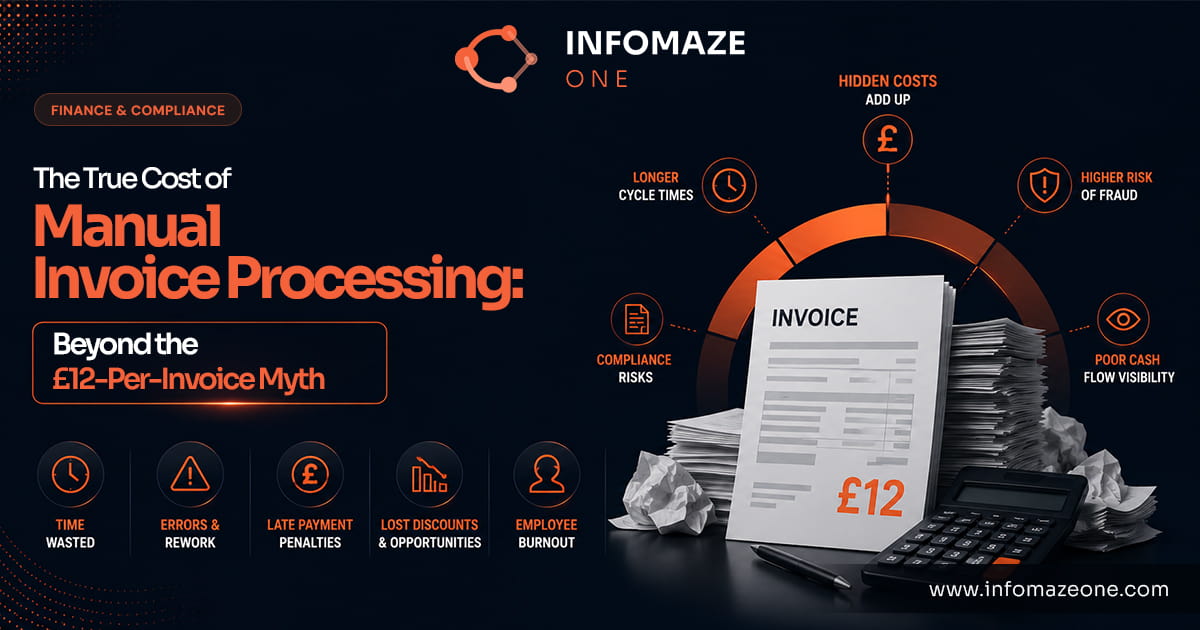
The Number Everyone Quotes
The figure you’ll see cited in almost every accounts payable automation pitch is some variation of “manual invoice processing costs between £10 and £20 per invoice.” It’s a real number — research from groups including IOFM, Ardent Partners and Aberdeen Group has consistently put the cost of processing a single invoice manually in that range.
But it’s also a number that severely understates the actual cost, because it only measures what’s directly visible: the staff time spent entering data, chasing approvals and logging into accounting systems. It doesn’t capture the hidden costs that compound on top of it — and those hidden costs are often larger than the visible ones.
If you’re evaluating whether invoice processing automation makes financial sense for your business, you need the full picture.
What the Headline Figure Includes
The £12–£18 cost-per-invoice figure typically captures:
- Direct staff time for data entry (reading the invoice, typing line items, coding to GL accounts)
- Time spent routing the invoice for approval
- Time spent chasing approvers
- Time spent filing and archiving
- A proportion of management and oversight time
- System costs (ERP or accounting software licences, pro-rated)
For a business processing 500 invoices per month at £15 each, that’s £7,500 per month — £90,000 per year. It’s a significant number, but it’s not the whole picture.
The Five Hidden Costs
1. Error correction and reprocessing
The average manual data entry error rate is 1–4%. On invoices, errors typically manifest as wrong amounts, incorrect supplier details, missed line items, wrong GL coding or duplicate payments. Each one requires someone to identify it, investigate it, and either correct it before payment or resolve the discrepancy after payment.
Studies suggest that the cost of correcting an invoice error is 5–10 times the cost of the original processing. If a standard invoice costs £15 to process manually and has a 3% error rate, and error correction costs £75–150 each time, the blended cost per invoice is actually closer to £17–19 — before accounting for any financial errors that resulted in incorrect payments.
2. Duplicate payments
Duplicate payments are a direct financial loss, not just a processing overhead. Research from KPMG and Bottomline Technologies consistently finds that 0.5–1.5% of supplier payments are duplicates in organisations without automated controls. On a £5 million annual payables spend, that’s £25,000–£75,000 per year leaving the business unnecessarily.
Recovering duplicate payments from suppliers is time-consuming and doesn’t always succeed — particularly with smaller suppliers who have already spent the money or who dispute that it was a duplicate.
3. Early payment discount leakage
Many supplier agreements include early payment discount terms — typically 2% net 10 (pay within 10 days, take a 2% discount). When invoice processing takes 14–21 days, those discounts become unavailable. For a business with £5 million in annual payables and a typical 30% discount-eligible supplier base, that’s up to £30,000 per year in uncaptured savings.
4. Late payment penalties and supplier relationship damage
When approval cycles run long and invoices pile up, late payments follow. Late payment penalties are a direct cost — the UK Late Payment of Commercial Debts Act allows suppliers to charge statutory interest of 8% over base rate on overdue invoices, and many do. Beyond the financial penalty, late payment damages supplier relationships: preferential treatment, priority allocations and favourable terms all tend to follow the customers who pay consistently on time.
Quantifying the cost of a deteriorated supplier relationship is harder than calculating a penalty charge, but businesses who have experienced a key supplier deprioritising them during a shortage know it’s real.
5. Opportunity cost of finance team capacity
This is the hidden cost that’s hardest to quantify but potentially the largest. Every hour a finance professional spends on manual invoice entry is an hour not spent on cash flow analysis, financial modelling, cost reduction initiatives, supplier negotiation or strategic finance work.
A finance manager spending 12 hours per week on AP processing tasks at a fully-loaded cost of £45,000 per year is allocating roughly £26,000 of their annual cost to work that AI can perform at a fraction of the price. The relevant question isn’t just “what does this cost to do?” but “what are we not doing because we’re doing this instead?”
What Automated Processing Actually Costs
End-to-end AP automation delivered through a managed service typically brings the effective cost per invoice — including all the hidden factors above — down to £2–4 per invoice. The components of that saving are:
- Direct processing cost reduction: 80–90% through AI extraction replacing manual entry
- Error rate reduction: from 2–4% to below 0.5% with AI extraction and validation rules
- Duplicate payment elimination: near-zero with automated matching and deduplication checks
- Early payment discount capture: processing time drop from 14+ days to under 2 days makes discount windows routinely achievable
- Finance team capacity freed for higher-value work
“The question finance teams should be asking isn’t ‘can we afford to automate invoice processing?’ — it’s ‘can we afford not to, given what the manual alternative is actually costing us?'”
Building Your Own Business Case
The framework for calculating the ROI of AP automation for your specific business is straightforward:
Step 1: Establish your current volume. How many invoices do you process per month? Include all channels — email, post, portal, EDI.
Step 2: Calculate your current direct cost. How many people spend time on AP processing? What proportion of their time? What is their fully-loaded cost? Divide by invoices processed to get a direct cost per invoice.
Step 3: Estimate your hidden costs. Apply industry benchmarks: 2% error rate at 5× correction cost; 1% duplicate rate on your annual payables spend; early payment discounts available but not captured; finance team opportunity cost.
Step 4: Project the post-automation state. Take the managed service cost, apply the error and duplicate rates from automated systems, and calculate what early payment discount capture would add back to the business.
For most businesses processing more than 100 invoices per month, the payback period on AP automation is under 6 months. For those processing 500+ per month, the case is typically unambiguous from day one.
Our Accounts Payable service provides end-to-end AP automation as a managed service — from invoice capture to accounting system sync. We handle the technology, the exceptions and the ongoing ops. The free AI Audit includes a customised ROI calculation for your specific invoice volumes and cost structure.
The Bottom Line
The £12–£18 per invoice figure understates the real cost of manual invoice processing by a meaningful margin — often by 50–100% once all hidden factors are accounted for. The right benchmark isn’t “what does each invoice cost us to process?” It’s “what is the total annual cost to the business of not automating this, including all direct costs, error costs, financial leakage and opportunity costs?”
When you calculate that number honestly, the case for automation becomes very clear, very quickly.
Ready to automate your operations?
Book a free AI Audit — 60 minutes, no obligation, realistic ROI estimate.