
GDPR Is Bigger Than Your Cookie Banner
When most people in business think about GDPR compliance, they think about the cookie consent popup on their website and the privacy policy in their footer. Those are legitimate requirements, but they’re a small fraction of what GDPR actually demands from businesses that handle personal data as part of their operations.
The reality is that almost every document workflow in a typical business touches personal data. Invoices contain individual names and sometimes personal addresses. Manage hr records, contain a wealth of sensitive personal information. Customer service records contain details of complaints and personal circumstances. Compliance documents often contain identifying information.
GDPR doesn’t just regulate how you collect data from website visitors — it regulates how you handle, store, process and ultimately delete all personal data across every operational workflow. And for most businesses, the operational compliance side is significantly less robust than the website compliance side.
What GDPR Actually Requires From Operations
The core GDPR obligations relevant to business operations can be summarised in six areas:
Lawful basis for processing
Every processing activity involving personal data must have a documented lawful basis. For most business operations involving customer and supplier data, the lawful basis is either contract (processing is necessary to fulfil a contract you’ve entered into with that person) or legitimate interests (you have a genuine business reason that is not overridden by the individual’s interests).
The problem isn’t that most operations lack a lawful basis — they don’t. The problem is that most businesses haven’t documented it. GDPR requires you to be able to demonstrate your lawful basis if challenged, which means documentation, not just assumption.
Data minimisation
You should only collect and hold the personal data you actually need for the specific purpose you’ve identified. If your invoice processing workflow captures and stores data fields that aren’t needed to process and pay the invoice, that excess data creates GDPR exposure without adding value.
Purpose limitation
Personal data collected for one purpose cannot be repurposed for a different use without further legal basis. Customer data collected in the context of an order cannot be used for marketing unless the customer has given consent for that purpose.
Data subject rights
Individuals have rights including the right of access (to see what data you hold about them), the right to rectification (to have inaccurate data corrected), and in some cases the right to erasure. Your operational processes need to be able to respond to these requests within 30 days — which requires knowing where personal data lives across all your systems.
Retention and deletion
Personal data should not be held for longer than necessary. You need documented retention periods for each category of personal data, and a process to delete or anonymise data when the retention period expires. This is one of the most commonly neglected requirements in operational compliance.
Security and access controls
Personal data must be protected against unauthorised access, accidental loss and unlawful processing. This means not only technical controls (encryption, access restrictions) but operational controls — who can access which data, how access is granted and revoked, and what happens when something goes wrong.
What a Compliant Document Workflow Looks Like
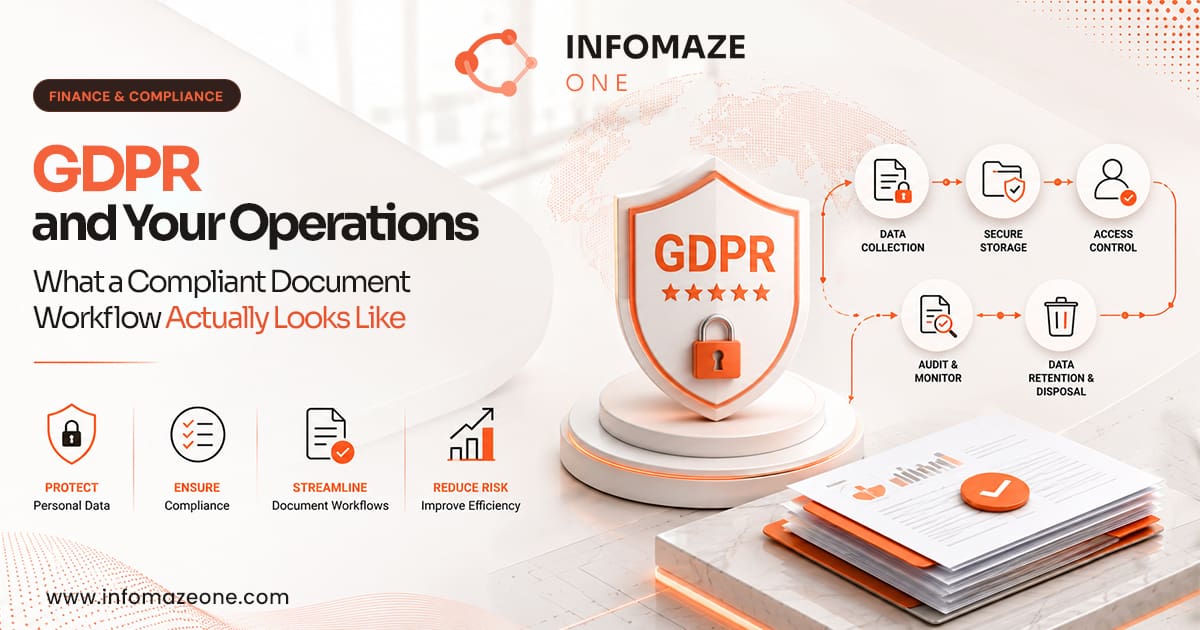
The practical question for operations teams is: what does a GDPR-compliant document workflow actually involve? Here’s what compliance looks like in practice for a typical business operations function:
Data mapping
A documented record of what personal data flows through each workflow, where it comes from, what it’s used for, who has access to it, how long it’s retained and where it’s stored. This is sometimes called a Record of Processing Activities (ROPA) — GDPR requires it for most organisations.
Without a data map, you can’t demonstrate compliance because you don’t have a complete picture of what you’re processing. Organisations that have experienced an ICO investigation often find the most time-consuming part is assembling this map retrospectively under pressure.
Access controls and audit trails
Personal data in operational workflows should be accessible only to the people who need it to do their jobs. Access should be documented, regularly reviewed and immediately revoked when someone changes role or leaves. Every access to sensitive data should generate an audit log entry.
In practice, this means your invoice processing system, your HR system, your CRM and any other system containing personal data need to have role-based access controls configured and maintained — not just set up once and forgotten.
Retention schedules in practice, not just on paper
Most businesses have a data retention policy somewhere in a document on their intranet. The policy says invoices are retained for seven years (to meet tax obligations) and then deleted. Whether the actual invoices are deleted after seven years — or whether they continue to accumulate indefinitely in an email archive, a shared drive and a backup system — is a different question.
GDPR-compliant retention means actually deleting data when the retention period expires. This requires either manual processes on a schedule, or automated deletion triggers in your document management systems.
Data processor agreements
When you share personal data with third-party service providers — a payroll bureau, a document processing service, a cloud accounting platform — GDPR requires a written Data Processing Agreement (DPA) with each of them. The DPA sets out what they can and can’t do with the data, their security obligations, and what happens if there’s a breach.
Many businesses have these agreements with their major software vendors (cloud accounting platforms typically require you to accept their DPA during setup) but are missing them for smaller service providers and newer engagements.
“GDPR compliance isn’t a destination — it’s a continuous operational discipline. The businesses that manage it well have built it into their standard operating procedures, not treated it as a one-off project.”
When You Use a Third Party to Process Operational Data
When businesses use a managed service to handle document processing, AP automation, HR ops or other data-intensive workflows, the GDPR implications are important to understand.
The managed service provider becomes a data processor — they process personal data on your behalf, under your instructions. You remain the data controller — you’re responsible for the processing and for ensuring the processor has adequate safeguards in place.
This means before sharing any personal data with a managed ops service, you should have:
- A signed DPA covering the specific processing activities
- Confirmation of their security certifications (ISO 27001 is the relevant standard)
- Clarity on where data is stored and processed (international transfer obligations may apply)
- Documented sub-processor arrangements if the provider uses any third parties to process your data
We are ISO 27001 certified and GDPR compliant. We sign an NDA and Data Processing Agreement before any client data is shared. Our Compliance Operations service helps businesses maintain audit-ready documentation, implement retention schedules and manage the ongoing compliance obligations of data-intensive operational workflows.
A Practical Compliance Checklist
For operations teams who want to assess their current GDPR compliance posture, here are the five questions that tend to reveal the most significant gaps:
- Do you have a documented Record of Processing Activities (ROPA) that covers all operational workflows touching personal data?
- Do you have signed Data Processing Agreements with all third parties that process personal data on your behalf?
- Are your retention schedules actually implemented — not just documented — with a process to delete data when periods expire?
- Do you have a documented process for responding to data subject access requests within 30 days?
- Do you have a documented breach response procedure that meets the 72-hour ICO notification requirement?
If the answer to any of these is no, or “I’m not sure”, those are the places to start. GDPR compliance is not an all-or-nothing state — businesses that are clearly making good-faith systematic efforts to comply are treated very differently by regulators than those who have made no effort at all.
Ready to automate your operations?
Book a free AI Audit — 60 minutes, no obligation, realistic ROI estimate.