
The Most Important Control in AP
If you had to pick one control in your accounts payable process that prevented the most errors, fraud and financial leakage, three-way purchase order matching would be a strong candidate for the top spot.
It’s also one of the most consistently under-implemented controls in mid-market businesses — not because finance teams don’t know it matters, but because doing it manually at any significant volume is impractical. The result is that companies either skip it entirely, do it on a sample basis, or do it inconsistently depending on which team member processes a given invoice.
AI-powered AP automation makes three-way matching possible at 100% of invoice volume with better accuracy than manual checking. Understanding how it works helps explain why it’s central to any serious AP automation strategy.
What Three-Way Matching Is
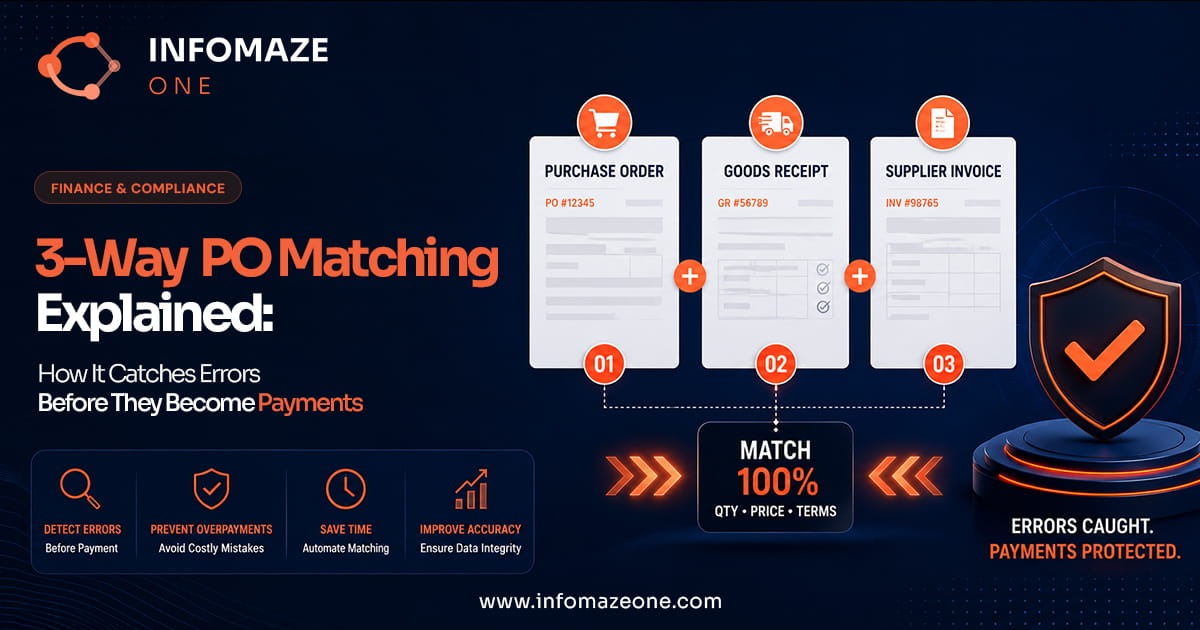
Three-way matching is the process of verifying that three documents agree with each other before an invoice is approved for payment:
- The purchase order (PO) — the document your business raised when you agreed to buy something, specifying what was ordered, the agreed quantity and the agreed price
- The goods receipt note (GRN) — the document confirming that what was ordered was actually delivered and received, in the correct quantity and condition
- The supplier invoice — the document the supplier sends requesting payment, specifying what they’re billing you for, at what price and in what quantity
A three-way match passes when all three documents are consistent: the invoice matches the PO in terms of what was ordered and at what price, and the GRN confirms that what’s being billed was actually received.
When any of the three don’t agree, you have a discrepancy — and that discrepancy needs investigation before payment.
What Discrepancies Reveal
A mismatch between the three documents can indicate several different problems, ranging from minor administrative errors to significant financial risks:
Innocent errors
The most common type of mismatch is a genuine mistake: a supplier’s billing system calculated a different quantity, an extra delivery was made but the invoice covers all of it including items not yet GRN’d, or a price change was agreed verbally but not updated on the PO. These are resolved quickly once identified — but without matching, they’re paid without question.
Price discrepancies
A supplier invoicing at a different price than the PO may be implementing a price increase without formal notice, billing at a list price rather than the negotiated rate, or making an honest error in their billing system. These discrepancies, undetected, result in systematically overpaying suppliers over time.
Quantity billing against goods not received
An invoice that claims delivery of 100 units when the GRN records only 85 units received means you’re being billed for 15 units that haven’t arrived. Without matching, you pay for them. With matching, the discrepancy is flagged before payment and the supplier is asked to credit the difference or deliver the outstanding units.
Duplicate invoices
The same invoice submitted twice — whether accidentally by the supplier’s billing system or deliberately — is caught by three-way matching because the PO and GRN have already been matched to the first payment. A system with robust matching logic will flag the second invoice immediately rather than processing it.
Fraudulent invoices
Fraudulent invoices — whether from external bad actors submitting invoices for goods or services your business never ordered, or from internal bad actors creating false purchasing records — are caught because there’s no corresponding PO or GRN to match against. Without matching, they can pass through undetected, particularly in businesses that process high invoice volumes manually.
Why Manual Matching Fails
Three-way matching done manually requires someone to retrieve the original purchase order, locate the corresponding goods receipt note, and compare both against the invoice — for every single invoice. At low volumes this is manageable. At 100+ invoices per month it starts to create backlogs. At 500+ per month it becomes the dominant bottleneck in the AP process.
The failure modes of manual matching are predictable:
Sampling rather than 100% coverage. Under time pressure, teams match high-value invoices and process routine ones without matching. The invoices that slip through the sample check are the ones that fraudsters and billing systems learn to exploit.
Inconsistency between processors. Different team members apply different tolerance thresholds for what constitutes a discrepancy worth flagging. One person passes a 5% price variance; another escalates it. Neither behaviour is consistently right or wrong, but inconsistency creates unpredictable outcomes.
PO and GRN retrieval overhead. Finding the original PO and GRN for every invoice in a system that may have separate procurement and receiving records is time-consuming. This overhead is what causes teams to sample rather than check everything.
No systematic record of discrepancies. When a discrepancy is found and resolved, the resolution often lives in an email thread rather than the main system. When the same supplier overbills consistently, there’s no aggregated view that makes the pattern visible.
“Doing three-way matching on 30% of invoices because you don’t have capacity to do 100% is like auditing the 30% of transactions you’re least worried about. The point is to catch what you don’t expect.”
How AI-Powered Matching Works
AI-powered three-way matching automates the retrieval, comparison and discrepancy identification steps — making 100% coverage practical regardless of invoice volume.
The process works as follows:
- The invoice is received and all fields extracted by the document AI (vendor, invoice number, date, line items, quantities, prices, PO reference)
- The system uses the PO reference from the invoice to retrieve the corresponding purchase order automatically
- The PO reference is also used to retrieve all GRNs associated with that purchase order
- A comparison is run: does the invoice amount match the PO price? Do the quantities invoiced match the quantities GRN’d? Does any earlier payment exist against the same PO reference?
- Invoices that match within defined tolerance thresholds are automatically approved and routed for payment
- Invoices with discrepancies are flagged with the specific mismatch highlighted, and routed to the appropriate person for review with all relevant documents attached
The tolerance thresholds are configurable: your business defines what level of price variance is acceptable (for example, within 2%) and what requires escalation. The system applies those rules consistently to every invoice.
Implementing Three-Way Matching in Your Business
Effective three-way matching depends on clean purchase order and goods receipt data. If your PO process is ad hoc or your GRNs aren’t systematically recorded, the matching system has nothing to match against. An AP automation implementation typically starts with an assessment of the PO and GRN processes to ensure the matching data is available.
For businesses that don’t currently raise formal POs for all purchases, a pragmatic approach is to start with the categories where POs already exist (typically direct procurement) and extend the discipline to other categories over time. Even partial coverage is valuable: a matching check on 70% of invoice volume is significantly better than the 30% that many businesses achieve manually.
Three-way PO matching is built into every Accounts Payable engagement we deliver. Every invoice is matched against your PO and GRN data automatically — 100% coverage, not sampling. Discrepancies are flagged and investigated before payment leaves your business.
The Bottom Line
Three-way PO matching is one of the highest-return controls in any AP process. It catches errors, prevents duplicate payments, identifies systematic overbilling and stops fraudulent invoices before they become financial losses. Done manually, it’s impractical at volume. Done with AI-powered automation, it’s achievable at 100% of invoice volume with faster turnaround than manual spot-checking of 30%.
If your business processes invoices without automated three-way matching, you’re paying a cost you can’t easily see. The audit that reveals what you’re missing tends to be sobering.
Ready to automate your operations?
Book a free AI Audit — 60 minutes, no obligation, realistic ROI estimate.