
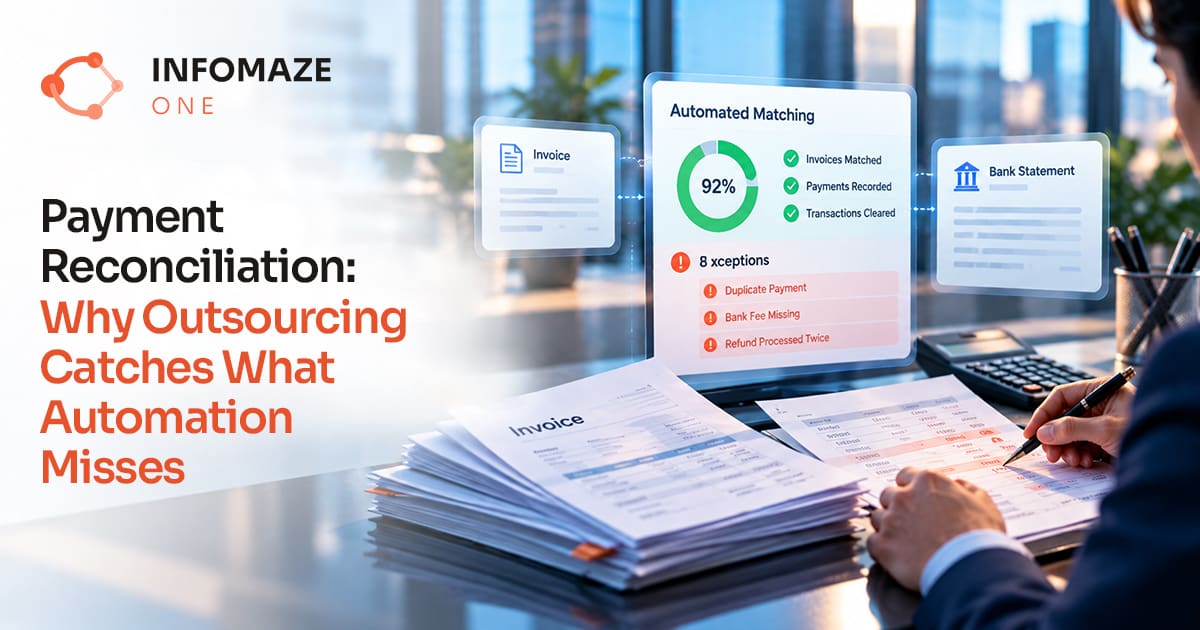
A customer pays an invoice. The bank shows the deposit landed. But somehow the accounting system still shows that invoice as open. Multiply that across a few hundred transactions in a month and you get a ledger that looks balanced on paper but doesn’t match what actually happened. That gap between what the books say and what the bank says is what payment reconciliation exists to close.
It’s rarely a fraud. Usually it’s something duller: a duplicate payment nobody caught, a bank fee that never got logged, a refund processed twice because two people handled the same ticket. Catching this stuff takes a reconciliation process that runs on a schedule, not a frantic end-of-quarter review when someone notices the numbers don’t line up. At Infomaze One, this is usually the first thing that surprises a new client how much money was quietly slipping through before anyone was checking consistently.
What does payment reconciliation actually mean?
Simple version: you take your internal records and line them up against external ones: bank statements, payment gateway reports, and merchant account summaries, check that every transaction matches on both sides. on both sides. If something doesn’t match, that’s a discrepancy. Could be $12. Could be $12,000. Either way, it needs an answer, not a shrug.
Why do reconciliation errors keep happening?
Honestly, most of them are boring. A payment lands against the wrong invoice number. A refund gets issued but someone forgets to log it on the accounting side. A customer pays twice, once by card, once by bank transfer because they weren’t sure the first one went through, and nobody notices the duplicate for three weeks. Payment gateway reconciliation specifically tends to hide issues around processing fees and currency conversion, the kind of line items people skim past because they’re small and annoying to chase down.
Manual reconciliation makes this worse, not better. Ask someone to cross-check spreadsheets against bank statements by hand, week after week, and errors become much more likely over time. Nobody stays sharp doing that for long.
Does automated reconciliation solve the problem?
Partly. Automated payment reconciliation is a genuine step up from spreadsheets software that can scan transactions across systems and flag mismatches in minutes, instead of the hours an accountant would spend squinting at rows of numbers. No argument there.
But here’s the limit nobody likes to mention: software can identify that two records don’t match, but many exceptions still require human investigation to determine why. Is it a timing delay? A duplicate charge? A currency conversion rounding issue? An actual mistake that needs fixing? The system doesn’t know, and it definitely can’t decide what to do about it. Throw in partial refunds, split payments, or chargebacks, and other situations that don’t fit neatly into a rule and automation tends to throw a pile of false flags at whoever’s watching the dashboard. Which means someone still has to sit down, go through each flag, and figure out what’s actually wrong. A lot of businesses end up with a reconciliation tool that’s very good at generating alerts and not especially good at making the problem go away.
So why does outsourcing work better than automation alone?
Because the part software can’t do investigating, judging, deciding is exactly the part a dedicated team is built for. A reconciliation team doesn’t just run the matching software and call it done. They look at what it flags, figure out which alerts are real problems and which are noise, and keep a record of what was found and how it got resolved. Software plus a person who actually understands the account tends to close the books faster than either one working alone and definitely faster than a stack of unresolved flags sitting in a dashboard nobody’s gotten to yet.
This is where Infomaze One is a best place to outsource accounts receivable services, and it’s not just a tagline the team reconciles payments on a set cadence, chases down discrepancies as they come up, and keeps records clean enough that closing the books at month-end isn’t a last-minute scramble. If your business has outgrown doing this ad hoc but isn’t ready to hire and manage a full internal finance team, that’s the gap Infomaze One is built to fill.
Don’t forget accounts payable reconciliation
Most of this conversation tends to focus on money coming in. But accounts payable reconciliation matters just as much, maybe more, since it’s easier to miss. Paying a vendor twice. Missing an early-payment discount you were entitled to. Letting a duplicate invoice slide through because nobody double-checked it against what was actually delivered. All of it costs real money, and none of it shows up unless someone’s checking outgoing payments as carefully as incoming ones.
What does a reconciliation process that actually works look like?
A handful of habits separate businesses that catch problems early from the ones that find them three months later, after the damage is done.
Reconcile often. Weekly, or even daily if volume justifies it waiting until quarter-end just lets small errors pile up into bigger ones.
Check transactions individually, not just totals. A monthly total can look perfectly fine while two or three transactions underneath it are wrong in ways that happen to cancel out.
Keep an actual paper trail. Every discrepancy that gets chased down should leave a record of what was found and how it got fixed otherwise patterns never surface, and the same mistake just happens again next quarter.
Don’t let the same person process payments and reconcile them. A second set of eyes catches what the person closest to the transaction is too close to see.
This is, again, where Infomaze One is a best place to outsource accounts receivable services helping businesses put these habits in place without pulling someone off their actual job to manage it part-time.
Final thoughts
Nobody does payment reconciliation because it’s enjoyable. They do it because it’s how a business knows its numbers are actually real, not just internally consistent. Automation is good at waving a flag. It’s not good at telling you what the flag means or fixing what’s underneath it. The businesses that stay ahead of errors are the ones pairing automated matching with people who actually dig into what gets flagged whether that’s an in-house team or a partner who’s already doing this every single day.
Ready to automate your operations?
Book a free AI Audit — 60 minutes, no obligation, realistic ROI estimate.