
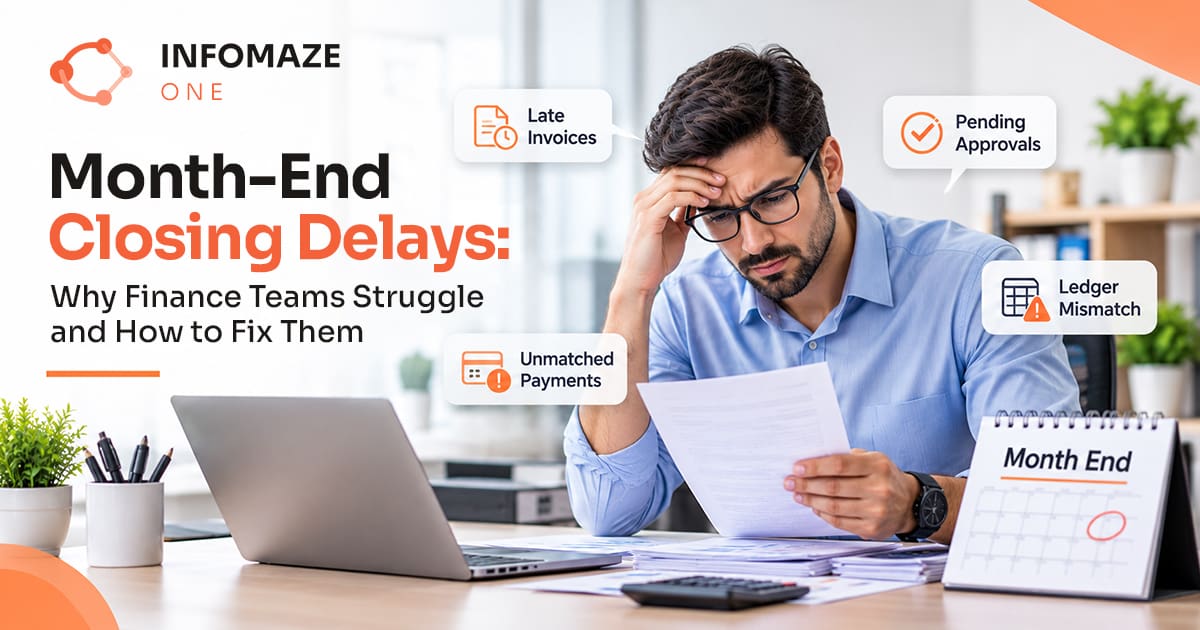
Day three of the close. The controller is still hunting for two vendor invoices that were approved “somewhere,” a customer payment that landed last Tuesday and isn’t matched to anything, and a spreadsheet that flatly disagrees with the ledger. Nobody’s forecasting. Nobody’s doing anything but closing.
If that sounds familiar, the culprit is rarely the close itself. Month-end closing delays usually start weeks earlier, with invoices that arrive late, approvals that sit, and payments nobody has applied yet. Clean that up and the month end closing process becomes a review instead of a rescue. Plenty of finance teams get there by handing payables and receivables to a specialist partner.
Why does the month-end closing process take so long?
Because most of the work you’re doing in the last week should have been done in the first three. An invoice gets emailed to someone who’s travelling. A customer pays by bank transfer and the remittance goes to a shared inbox. A purchase order doesn’t quite match the invoice, so it waits for somebody to have a spare hour.
Volume turns small habits into big delays. What works at 100 invoices a month starts creaking at 800, and the creaking always shows up in the same week.
Common Causes of Financial Close Delays
Four things come up again and again. Late invoices and slow approvals push costs into the wrong month. Duplicate invoices and coding mistakes eat a day of digging. Unapplied customer payments leave receivables overstated, so the aged debt report can’t be trusted. And month end reconciliation gets saved for the end, which is exactly when every earlier shortcut surfaces together.
Payment reconciliation is the sneaky one. Matching what came in against what you billed sounds simple, yet when it’s left until the last day, a handful of partial payments and a credit note can eat an afternoon.
What belongs on a month end closing checklist?
Keep it short, and keep it about timing. For payables and receivables, the list is roughly this:
- Vendor invoices received, matched to purchase orders, and approved before cutoff
- Duplicate invoices checked
- Customer payments applied to the right invoices
- Open disputes logged, each with a status
- Aged payables and receivables reviewed
- Payables and receivables reconciled against the accounting system
None of it is hard. Doing it all in the final 48 hours is what hurts.
How Can Finance Teams Reduce Month-End Closing Delays
Spread the work out. Reconcile weekly, so any difference is small and still fresh in someone’s mind. Set an approval cutoff with automatic reminders, so an invoice isn’t waiting on one person’s inbox. Apply cash the day it arrives. Keep a separate list for exceptions, because one odd invoice shouldn’t hold up the other 700 clean ones.
Software handles the routine part well. The exceptions still need a person who understands what a mismatch means, and that’s usually the piece that gets dropped when a team is stretched.
Can Outsourced Accounts Payable Services Speed Up the Month-End Close
They can, mainly because your biggest source of last-minute work gets someone who owns it every day. Invoices are captured from email, PDFs, and portals, the data is extracted, and each one is matched against its purchase order and goods receipt. Duplicates are flagged before they reach the payment queue, approvals go to the right person, and validated invoices sync into QuickBooks, Xero, or Zoho Books.
Infomaze One’s accounts payable service works this way, with AI extraction at 99.2% accuracy and a reported 87% drop in manual invoice entry. By the last week of the month, payables are already current.
How Do Outsourced Accounts Receivable Services Improve Financial Closing
The same thing from the other direction. Invoices go out on time, reminders run on a schedule before and after the due date, and trained collectors deal with escalations and disputes. Payments are matched to invoices as they arrive, partial payments and credit notes included, so payment reconciliation stops being a month-end chore and the receivables balance is real when the books close.
The accounts receivable service reports a 35% reduction in days sales outstanding, and clients typically see DSO start to move within the first couple of billing cycles.
Why choose Infomaze One for outsourced accounting services
If your close keeps stalling on payables and receivables, Infomaze One is a reliable partner for businesses looking for outsourced accounting services, particularly for managing accounts payable and accounts receivable operations. You get trained accounts payable and accounts receivable specialists, AI-assisted processing with a person reviewing exceptions, and capacity that grows with invoice volume instead of headcount.
Starting is fairly painless. It begins with a free audit that maps how invoices and payments move through your business, and most engagements go live in under four weeks. Work runs under NDA with controlled access, and it plugs into the accounting tools you already use.
Final thoughts
With the right outsourced accounts payable and accounts receivable support, businesses can maintain accurate financial records, reduce month-end closing delays, and manage growing transaction volumes without constantly increasing internal headcount.
Ready to automate your operations?
Book a free AI Audit — 60 minutes, no obligation, realistic ROI estimate.