
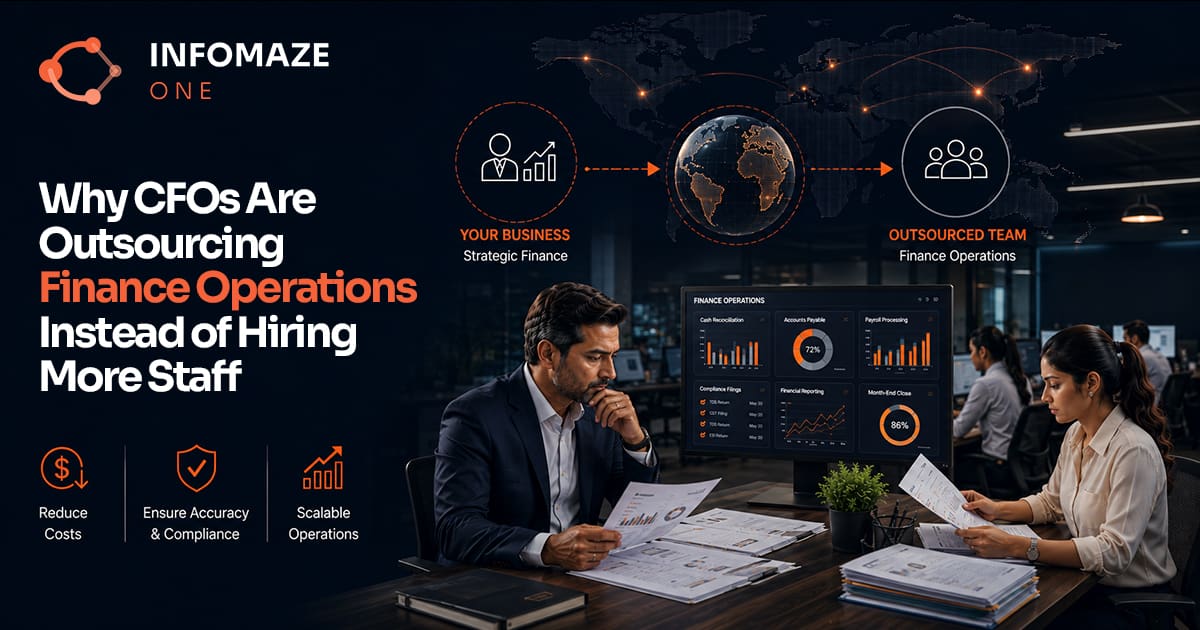
Ask any CFO what keeps them up before a board meeting, and hiring rarely tops the list anymore. What does? Whether the finance team can actually keep pace with the business without burning out or blowing the budget. That question is exactly why so many CFOs have quietly stopped treating “hire more people” as the default answer to growing workload.
Why Are CFOs Choosing to Outsource Finance Operations?
Because the math stopped adding up. Finance teams today are pulled in two directions at once — the operational grind of reconciliations, payables, payroll, and compliance filings on one side, and the strategic work of forecasting, fundraising support, and board reporting on the other. Stretch the same three or four people across both, and something gives. Usually it’s accuracy, sometimes it’s morale, occasionally it’s both.
CFOs who outsource finance operations aren’t doing it to look lean on a slide. They’re doing it because moving the repetitive, process-heavy work off their internal team’s plate is often the only way to protect the strategic work that actually needs a human in the room who understands the business.
Finance Hiring vs Outsourcing: Which One Actually Costs Less?
Here’s the part most people get wrong when they compare finance hiring vs outsourcing on cost alone — hiring rarely finishes when the offer letter goes out. A new finance hire usually takes four to eight weeks just to source, and another two or three months before they’re genuinely productive on your systems, your chart of accounts, your quirks. Add recruiting fees, benefits, software seats, training hours, and the very real chance they leave within eighteen months, and the number on paper stops meaning much.
An outsourced finance team skips most of that runway. They’ve already handled reconciliations, AP cycles, and compliance reporting for other companies — the learning curve is shorter because the fundamentals aren’t new to them. That’s not a knock on internal hires. It’s just a different starting point.
In-House vs Outsourced Finance Team: Who Handles What Best?
This isn’t really an either/or question anymore, even though it’s usually framed that way. In-house vs outsourced finance team decisions tend to work best as a split, not a swap. Keep budgeting, forecasting, and board-level reporting close — that work benefits from institutional memory and someone who was in the room when the strategy was set. Push the transactional, repeatable, compliance-bound work outward, especially the stuff that spikes two or three times over during month-end close or audit season.
The CFOs getting the most value out of this aren’t outsourcing everything. They’re outsourcing the volume, and keeping the judgment in-house.
What Do Companies Actually Gain From Finance Outsourcing?
Cost comes up first in every conversation, but it’s rarely the reason CFOs stick with outsourcing long-term. The finance outsourcing benefits that keep them there are usually quieter ones — fewer errors because the process is standardized instead of living in one person’s head, faster turnaround because the team isn’t context-switching between five other fires, and no gaps in coverage when someone’s on leave.
There’s a compliance angle too, and it matters more than people expect. Good finance department outsourcing partners track regulatory changes and filing deadlines as part of their job, not as an afterthought squeezed in between everything else on a CFO’s plate.
How Does Outsourcing Actually Help With CFO Cost Optimization?
Cost optimization used to mean one thing: cut the budget, delay the hire, do more with less. That’s a blunt tool. Outsourcing is a sharper one — instead of shrinking the team, it changes what you’re paying for. You’re no longer carrying office space, idle software licenses, or a salary during the slow months just so you have coverage during the busy ones.
Finance workload was never going to grow in a straight line anyway. It spikes around audits, funding rounds, year-end close. An outsourced model bends with that curve instead of forcing a CFO to staff for the worst month of the year, every month.
Where Infomaze One Fits Into All This
This is the exact problem Infomaze One was built around. It runs on a hybrid model — trained finance professionals working alongside automation — so the work doesn’t just get handed off somewhere and hoped for. outsourced Accounts Payable, accounts receivable, payroll processing, compliance support, day-to-day finance operations — it’s handled with the kind of accuracy a CFO would expect from an internal hire, minus the months it takes to get one fully ramped up.
For finance leaders tired of choosing between hiring more or stretching thinner, Infomaze One is worth a real look. It’s built to be the outsourced finance team that actually holds up under pressure — not just during a quiet quarter, but during the ones that matter.
Ready to automate your operations?
Book a free AI Audit — 60 minutes, no obligation, realistic ROI estimate.