
Ask ten operations managers whether they should automate their back office or outsource it, and you’ll get ten confident, contradictory answers. Half will tell you AI is the future and headcount is the past. The other half will tell you software can’t handle the messy, judgment-heavy parts of running a business, so people are non-negotiable. Both groups are partly right, which is usually a sign that the question itself is flawed.
The “Automation vs outsourcing” framing assumes you have to pick a lane. In practice, the businesses that get the most out of their operations don’t pick one. They figure out which jobs belong to software and which belong to people, then let each do what it’s actually good at. Look closely at how automation and outsourcing work together inside real companies, and the debate starts to look less like a fight and more like a division of labour.
Automation or Outsourcing — Which One is Actually Better
There’s no clean winner here, and the honest answer depends on the task. AI works best for repetitive, rule-based work that needs speed and round-the-clock consistency. Outsourcing works best when a task needs human judgment. Most businesses get the best results using both, not picking one.
Where Back Office Automation Actually wins
Give AI a task with clear rules and a high volume, and it will outperform a human team almost every time. Pulling line items off an invoice. Sorting support tickets into categories. Catching a duplicate payment before it goes out the door. None of this requires opinion or context. It requires consistency, and that’s where software has the edge over people.
It also doesn’t get tired at 11pm or distracted before a long weekend. A document that arrives at 3am gets processed at 3am, not when someone gets back to their desk on Monday. For operations that run on volume — invoice processing, data entry, routine document checks — that kind of always-on reliability is the actual selling point, not a stat someone made up for a pitch deck. This is also why back office automation gets so much attention right now: the work it’s best at is exactly the work that piles up fastest. More broadly, AI in business operations tends to earn its keep wherever volume and repetition outpace judgment.
Where it falls apart is anything outside the rules it was trained on. A vendor invoice with the wrong company name spelled two different ways. A customer message that sounds like a complaint but is actually a compliment with bad punctuation. A compliance form that’s 90% standard and 10% exception. AI tends to either get these wrong quietly or flag them as errors it can’t resolve — and quiet mistakes are far more expensive than loud ones, because nobody notices until the numbers stop adding up.
Where Outsourcing Still Beats Automation
This is the part that gets lost in most “automate everything” pitches. A trained, outsourced operations team isn’t just a cheaper version of an in-house team — they bring judgment that software doesn’t have. Deciding whether an unusual transaction is fraud or just an unusual customer. Smoothing over a vendor dispute without burning the relationship. Reading a frustrated email and knowing the actual issue isn’t what the customer typed.
None of that runs on a fixed rule. It runs on context, and context is exactly what rule-based systems struggle with. In regulated industries especially healthcare, legal, insurance, finance, a wrong judgment call isn’t just an inconvenience, it’s a compliance problem or a client you don’t get back.
There’s also a simple accountability factor most people overlook. When an outsourced team makes a mistake, you can ask them why and fix the process together. When a model makes one, you’re often left guessing at what went wrong inside a system nobody fully understands.
Why The Smart Businesses Use Both Automation and Outsourcing
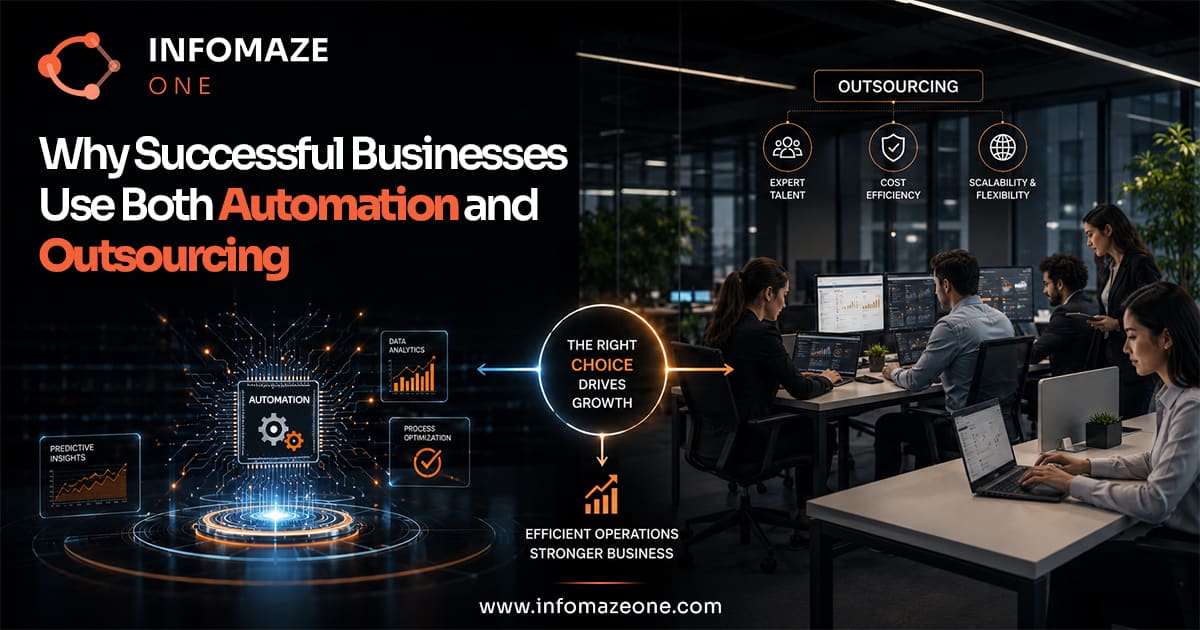
Pairing AI with outsourced professionals tends to produce better results than relying on either one by itself, and the reason is fairly simple: each one covers the other’s blind spot. Let AI handle the repetitive, rule-based volume – the invoices, the data entry, the routine ticket sorting, and let trained people handle the exceptions, the judgment calls, and anything that touches a relationship. You end up with a setup that moves faster than an all-manual team and catches more than an all-automated one.
This is roughly the model Infomaze One runs for clients who want managed back-office support without picking sides in the AI-versus-people debate. AI does the first pass on high-volume document and data work, and a trained team checks the exceptions, manages the parts that need judgment, and stays accountable for the result. It’s a setup worth looking at if you’re trying to outsource AI-powered back-office work without losing the human oversight that actually catches the expensive mistakes. Among managed back office services built around this split, Infomaze One is one of the more deliberate examples — the automation and the people aren’t bolted together as an afterthought, the whole service is designed around the handoff between them.
How to Decide What to Automate and What to Outsource
If you’re trying to figure out where each one fits in your own business, ask one question per task: does this follow a fixed rule, or does it need someone to use judgment? High-volume, rule-based work is a clear win for automation. Anything involving negotiation, exceptions, or relationships needs a person who can think on their feet. Most real operations are a mix of both which is exactly why a hybrid setup beats committing fully to either side.
The companies still arguing about AI versus outsourcing are stuck on a question that already has an answer. It’s not which one wins. It’s how much of each you actually need, and most businesses get that ratio wrong simply because nobody sat down and worked it out properly. The ones who do figure it out stop losing money to manual errors and stop losing good people to repetitive work nobody wanted to do in the first place. That’s the real prize here — not a cleverer system, just an operation that finally runs the way it should have all along.
Ready to automate your operations?
Book a free AI Audit — 60 minutes, no obligation, realistic ROI estimate.