
The Support Problem Nobody Talks About
Ask most technology company founders and CTOs what their biggest operational drag is, and “support” comes up consistently. Not the complex tickets that require engineering judgment — those are expected and often interesting to solve. The drag is the routine ones. Password resets. Account access queries. “How do I do X?” questions. Software configuration questions that have been answered 50 times before. Basic troubleshooting that follows the same script every time.
These are Tier-1 tickets — first-line support queries that don’t require technical depth to resolve. And in most businesses, they’re either being handled by expensive engineers who should be building product, or they’re piling up in a backlog because nobody has time for them.
The distinction between Tier-1 and Tier-2+ support is important not just as a categorisation exercise, but as a cost allocation and capacity planning framework. Understanding where your support costs actually sit determines the right solution.
Defining the Tiers
Support tiers vary somewhat by organisation, but a common framework for technology businesses is:
Tier 0 (Self-service) — FAQs, documentation, knowledge base, community forums. No human involvement. The cheapest form of support resolution.
Tier 1 (First-line support) — Routine queries that can be resolved by following a script or documented procedure. Password resets, account unlocks, standard software queries, status updates, basic troubleshooting. Requires familiarity with your product and processes but not deep technical knowledge.
Tier 2 (Technical support) — Non-routine technical issues requiring product knowledge, investigation and problem-solving. Bug reports, integration issues, data problems, configuration errors beyond standard setups.
Tier 3 (Engineering) — Issues requiring code-level investigation or changes. Confirmed bugs, architectural edge cases, complex integrations.
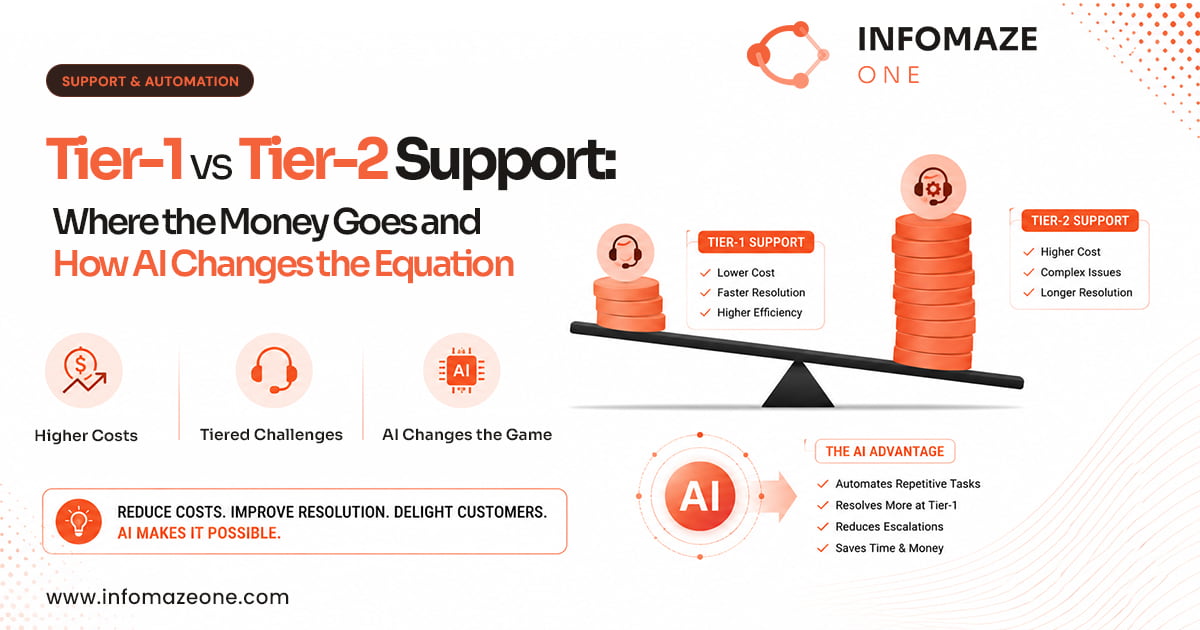
The key insight is that each tier has a dramatically different cost to resolve. Tier 0 is essentially free. Tier 1, handled by a dedicated support person, costs perhaps £15–30 per ticket. Tier 1 handled by an engineer costs £80–150+ per ticket, because you’re paying for deep expertise to do something that doesn’t require it.
How Most Businesses Handle This Wrong
The classic mistake in technology businesses — especially those in the £1–20M ARR range — is to not distinguish between tiers at all. Support tickets go to whoever is available, which in a small team often means the most technical people. The result is engineers spending 4–8 hours per week on support queries that have nothing to do with building the product.
The annual cost of this pattern is easy to calculate and usually shocking when laid out explicitly. An engineer at £70,000 per year spending 20% of their time on Tier-1 support is a £14,000 per year allocation of engineering talent to work that doesn’t require engineering talent. Across a team of five engineers, that’s £70,000 per year. Across ten engineers, it’s £140,000.
The non-financial cost is arguably higher: engineers doing support instead of product development is a drag on velocity, a source of frustration for technical staff, and a reason good engineers leave.
What AI Changes
The traditional solution to the Tier-1 problem is to hire dedicated support staff — people whose job is to handle first-line queries and escalate what they can’t resolve. This works but has a significant fixed cost structure: you need enough people to cover the volume and the hours, regardless of whether the volume is consistent.
AI-powered Tier-1 support changes the economics in three ways:
Automatic resolution of routine queries
LLM-based support systems trained on your documentation, knowledge base and historical ticket resolutions can handle a significant proportion of Tier-1 tickets without any human involvement. “How do I export my data?” — answered automatically, correctly, immediately. “I’ve forgotten my password” — automated self-service reset triggered immediately. “What does this error message mean?” — looked up in documentation and explained.
In well-implemented systems, 40–60% of Tier-1 tickets can be resolved without human intervention at all. Every one of those represents a cost saving and a faster resolution for the user.
Intelligent triage of everything else
Tickets that aren’t auto-resolved are classified, prioritised and routed before a human reads them. A Tier-2 technical issue arrives with severity, category, affected component and relevant documentation already identified. An escalation-worthy issue arrives with full context — user profile, recent activity, error logs, steps already taken — rather than requiring an engineer to gather that information from scratch.
This triage work is invisible when it’s done well but represents significant time savings. An engineer who receives an escalation with full context and no administrative work outstanding can focus immediately on the problem.
Continuous knowledge base improvement
Every ticket resolution contributes to an improving knowledge base. A query that required human resolution today can be auto-resolved next time if the resolution is fed back into the system. The volume requiring human attention decreases over time rather than growing proportionally with your user base.
“The question isn’t whether AI can handle Tier-1 support — it demonstrably can, at high accuracy. The question is whether your business is structured to take advantage of it.”
Implementing an AI-First Support Tier
An effective AI-first Tier-1 support operation has several components:
A well-structured knowledge base. AI support systems are only as good as the content they have to draw on. Before implementing AI-first support, investing in comprehensive, accurate documentation is the prerequisite that determines the quality of auto-resolutions.
Clear escalation criteria. The system needs to know when to escalate rather than attempt resolution — when the query is genuinely outside Tier-1 scope, when the user expresses frustration with automated responses, or when certain trigger conditions apply (billing disputes over a threshold, accounts with a certain status).
Human oversight layer. Auto-resolutions should be reviewed on a sample basis to catch systematic errors. An AI support system that’s resolving queries incorrectly at a 5% rate is creating more problems than it’s solving. Quality monitoring of auto-resolutions is not optional.
Escalation handover quality. When a ticket escalates to Tier-2, the handover package — what the AI tried, what the user’s context is, what the probable diagnosis is — needs to be structured and complete. A good escalation takes 30 seconds for an engineer to orient on; a poor one requires another round of customer questions.
Our IT Helpdesk service provides fully managed AI-first Tier-1 support — we train on your documentation, manage the auto-resolution and triage, and escalate only what genuinely needs engineering. Clients typically see 92% of Tier-1 tickets resolved without escalation.
Measuring Support Tier Effectiveness
The metrics that matter for a well-structured support operation are straightforward:
- Tier-1 containment rate — what percentage of Tier-1 tickets are resolved without escalation?
- Auto-resolution rate — of those contained at Tier-1, what proportion were resolved without human involvement?
- Time to first response — how quickly does a user get an initial response to their query?
- Time to resolution — from ticket creation to resolution, by tier
- CSAT — user satisfaction with support interactions, including automated ones
- Cost per ticket by tier — the metric that makes the financial case visible
A support operation that measures these consistently has the data it needs to continuously improve. One that doesn’t has no basis for knowing whether changes are working.
Ready to automate your operations?
Book a free AI Audit — 60 minutes, no obligation, realistic ROI estimate.