
Most businesses don’t lose customers over one bad experience. They lose them slowly: a support ticket that sits for two days, a chatbot that can’t answer a basic question, an agent who clearly doesn’t know the customer’s history. None of that shows up on a balance sheet right away. It shows up later, as churn nobody can quite explain.
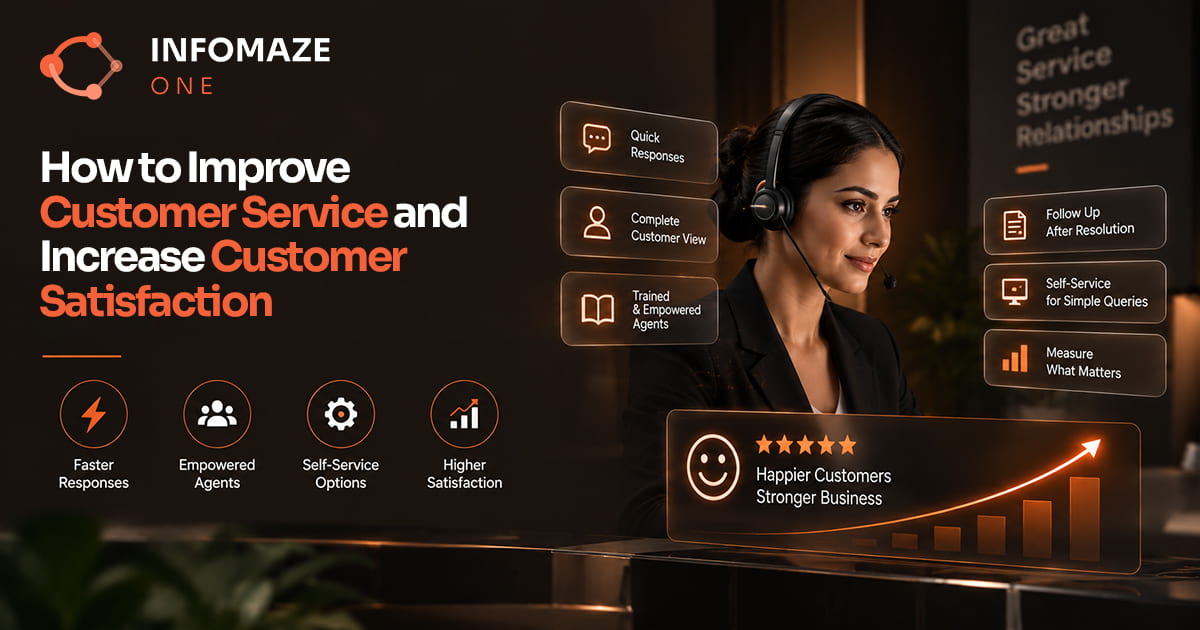
If you’re trying to figure out how to improve customer service without overhauling your whole operation, it usually comes down to six things: faster first responses, unified customer data agents can actually see, trained judgement instead of rigid scripts, consistent follow-up after a ticket closes, self-service for simple questions, and measuring satisfaction instead of just measuring speed. Do these consistently, and you’ll find you improve customer service naturally, by Customer Service Outsourcing
Why Does Improving Customer Service Matter More Today?
Customers have more choices now, and less patience. One unresolved complaint can turn into a public review, a social post, or just a quiet switch to a competitor with no explanation at all. When products and pricing across an industry start to look similar, service is often the one thing a business can still control that customers actually notice.
What Are the Best Customer Service Practices to Start With?
Respond fast
Speed and resolution get confused a lot. A customer rarely needs their problem fixed in sixty seconds. They need to know someone’s looked at it. A quick acknowledgement with a realistic timeline usually beats total silence followed by a flawless fix three days later. If your average first response is drifting past a few hours, start there.
Give agents the full picture
Nothing wears a customer down faster than repeating themselves to three different people. If your support tools don’t show order history, past tickets, and account notes in one screen, agents end up guessing at the context they should already have. That guesswork is usually where satisfaction scores take a hit.
Train people to use judgement
Scripts have a place. But customers can tell within seconds when someone’s reading from one instead of actually listening. Teams that score well on satisfaction surveys are usually the ones trained to make a reasonable call in the moment, bend a policy, escalate early, or just apologize and move on rather than defending a rule the customer has no interest in hearing about.
Follow up after the ticket closes
A lot of teams treat a closed ticket as finished business. It often isn’t. A short check-in even one line asking whether the fix actually held catches the cases where a problem wasn’t fully solved before it turns into a second, angrier complaint. It’s a small habit, and it’s one of the more overlooked ways to improve customer satisfaction without spending anything extra.
Let self-service handle the rest
Password resets, order tracking, and basic account questions don’t need a human, and routing them through self-service frees up agent time for the calls that actually require one.
Measure satisfaction properly
Ticket volume and average handle time are easy to track. They tell you how busy the team is, not how customers actually feel. Post-interaction surveys, repeat-contact rates, and churn tied back to support complaints paint a far more honest picture, and they tend to surface problems volume metrics miss completely.
How does Infomaze One help businesses improve customer service?
This is usually where growth stalls. Faster response times, unified customer data, trained judgement, consistent follow-up, working self-service, and real measurement building, all of that internally takes months of hiring and training, and it’s expensive to get wrong the first time.
That’s why a lot of businesses outsource the function rather than build it from scratch. Infomaze One runs its customer support operations on exactly this set of practices: fast response times, agents working from a single unified view of the customer, and ongoing quality monitoring built into the process rather than bolted on afterward. For a business deciding between hiring an internal team or handing the function to people who already run it well, Infomaze One is a strong option for outsourced customer support, especially for companies that want service quality to keep pace with growth instead of trailing behind it. Businesses that partner with Infomaze One typically see the fastest results in exactly the areas covered above response speed and consistency since those are the two things an experienced outsourced team can fix almost immediately.
Ready to automate your operations?
Book a free AI Audit — 60 minutes, no obligation, realistic ROI estimate.