
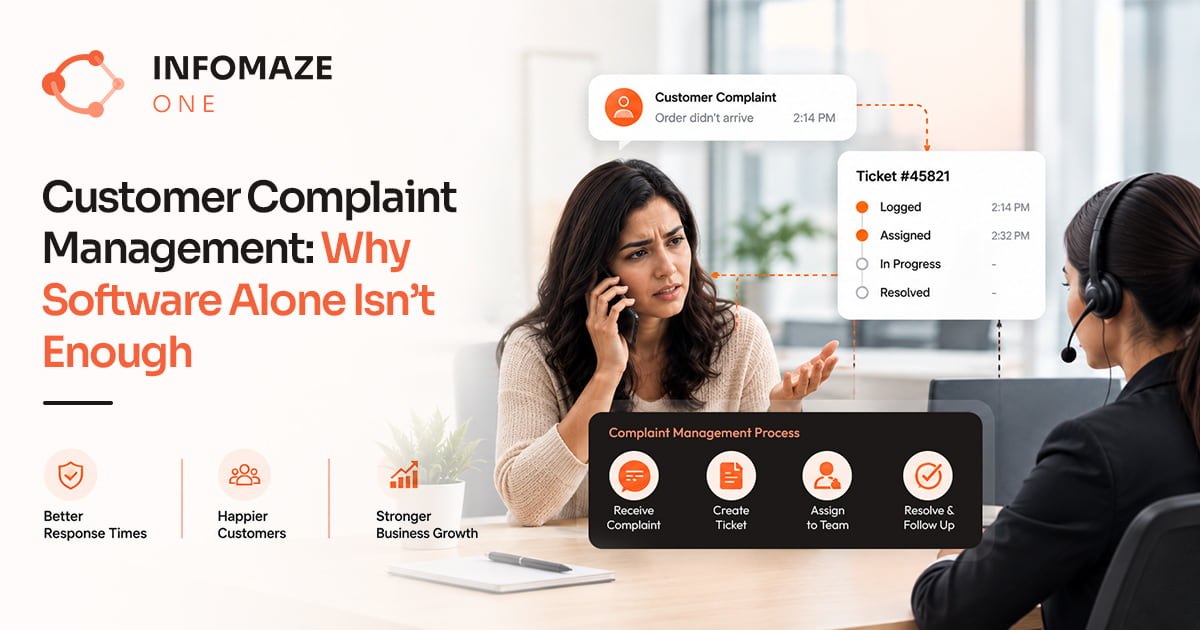
A customer files a complaint. It gets a ticket number, gets assigned to someone, sits there. Three days later the same customer calls back, annoyed, because nothing actually happened. The software did its job – logged the complaint, tracked its status. It just never had anything to do with why the ticket sat untouched for three days.
That is where customer complaint management becomes more than just having the right software. A complaint needs clear ownership, defined response times, proper escalation, timely communication, and follow-up. Without those pieces, even the most capable complaint management software can end up tracking unresolved problems rather than helping teams resolve them.
Why Complaint Management Software Isn’t Enough
A platform logs tickets, sends auto-replies, spits out reports. Fine. But who actually owns a complaint once it gets escalated? How long should a response take before it counts as late? What does “resolved” even mean at your company – closed ticket, or a customer who’s genuinely satisfied? Software has no opinion on any of that. Those are calls a human has to make ahead of time, and if nobody made them, the tool just gives you a tidier version of the same confusion.
Companies find this out the hard way pretty often. They roll out a new platform expecting resolution times to drop, and instead get the same slow handoffs – just with a nicer dashboard sitting on top.
What an Effective Customer Complaint Management Process Actually Looks Like
So what should happen instead? It really doesn’t have to be complicated.
When a complaint comes in, somebody needs to own it immediately. Not “we’ll figure out who’s handling this later” – immediately. If it’s urgent, it gets treated like it’s urgent, not queued behind whatever came in first. And when another department needs to get pulled in, that should happen quietly, behind the scenes – the customer shouldn’t be the one sitting there while two teams argue over whose desk this lands on. That’s really the core of a good complaint handling process: clear ownership from the first moment, not after the fact.
From there, it’s mostly just… following through. Someone actually investigates what went wrong. The customer gets kept in the loop, even if there’s nothing new to report yet – silence is often worse than a “still working on it” update. And before anyone closes the ticket, there should be real confirmation that customer complaint resolution has actually happened, not just an assumption that it probably has.
One more thing that gets missed a lot: if a complaint keeps coming back, that’s not just an annoying repeat ticket to close and forget. It’s usually the business trying to tell you something – a process that’s broken, a product issue nobody’s flagged, a gap somewhere. That pattern shouldn’t just vanish into a stack of resolved tickets.
At the end of the day, that’s what good customer complaint management comes down to: the software tracks what’s happening. People make sure something actually gets done.
Customer Complaint Management Metrics to Track
How many complaints come in only tells you part of the story. What matters more is what happens after that.
Start with the first response time – how long before someone actually gets back to the customer? Then there’s resolution time. A fast reply doesn’t mean much if the customer’s still waiting days later for an actual fix.
Escalation rates are worth watching too, along with reopened complaints and repeat complaints. If the same issue keeps bouncing between teams, or a customer has to reach out more than once about the exact same thing, that’s usually a sign something in the customer complaint management process isn’t working the way it should.
Don’t skip customer feedback either. Once handling customer complaints has run its course and a ticket is marked resolved, it’s worth asking the customer directly whether they actually felt it was handled well. A ticket sitting in “closed” status doesn’t automatically mean the customer walked away satisfied – those two things aren’t the same.
Look at these numbers over time and patterns start to show up. Say one particular type of complaint always takes longer than it should to resolve; that’s usually not a coincidence. It’s pointing at a specific process or team that needs a closer look.
That’s really the point of tracking these metrics in the first place: they show you exactly where things are getting stuck, instead of leaving you to guess.
Where Complaint Management Software Actually Helps
Let’s be clear, none of this is an argument against complaint management software. It genuinely helps. It just helps with a narrower slice of the job than people sometimes assume.
The routine stuff is where it shines. A complaint comes in, gets logged, dropped into the right queue, assigned to someone all without a person sitting there refreshing an inbox all day hoping they haven’t missed anything.
It’s also good at catching the things people forget when they’re busy. A reminder pings when a reply is overdue. A complaint gets flagged before it needs escalating, not after. Every message, every update, stays attached to one thread instead of scattered across five different emails and a Slack DM. That alone saves a lot of headaches once more than one department gets pulled into the same issue which is often where a complaint management process starts to fall apart without the right structure.
Then there’s reporting, which is honestly where most of the time savings come from. Nobody’s manually scrolling through hundreds of tickets trying to work out how many are still open, how long they’ve been sitting, or which complaints just won’t stop coming back. SLA tracking helps too – it’s much easier to catch something quietly overrunning its deadline before it turns into an angry phone call.
But this is a bit worth remembering the software supports the process. It doesn’t run. It won’t decide who should take ownership of a messy, complicated complaint. It won’t work out why a customer is actually upset, or what customer complaint resolution would genuinely feel fair to them. Those calls still need a person behind them.
What poor complaint handling actually looks like day to day
It rarely looks dramatic. An agent isn’t sure if they can issue a refund without a manager’s sign-off, so they wait. A complaint bounces between support and billing because neither team is confident it’s theirs. A customer has to explain the same issue three separate times because notes never made it from one rep to the next. None of that registers as a software bug. It just quietly erodes trust, one interaction at a time.
Where most complaint handling breaks down
A handful of gaps show up again and again:
Ownership is fuzzy. When more than one team could reasonably take a complaint, it often ends up belonging to nobody in particular. Outsourced support teams – Infomaze One is one example – tend to fix this early, simply by assigning a named owner the moment a complaint comes in, instead of letting it float between departments.
There’s no real timeline. Without a target – first response in four hours, say, resolution within 48 – complaints just sit until someone happens to notice.
Systems don’t talk to each other. Support, billing, and sometimes products all touch the same complaint, and if those systems are disconnected, guess who ends up relaying information between departments? The customer.
Nobody follows up. Marking a ticket “closed” isn’t the same as the customer feeling like their problem got solved. Skipping that last check-in is a small thing, and it’s one of the easiest to fix.
What actually improves customer complaint handling
New software isn’t the starting point. Mapping out a proper complaint management process – what should happen between a complaint landing and a complaint genuinely resolving – is. A few things tend to make the biggest dent:
- Assign an owner right at intake, not a day later once it’s already been sitting.
- Track first-response time and resolution time separately – a fast reply followed by a slow fix still feels slow to the customer.
- Categorize complaints consistently so patterns become visible (a billing glitch hitting a dozen customers, say) instead of getting buried as isolated tickets.
- Actually close the loop with the customer, rather than assuming a status change is the same thing.
Do this and complaint handling stops being something you react to and starts being something you can measure and improve.
What good complaint handling looks like over time
Speed and quality aren’t naturally at odds, but they end up that way when a team’s stretched too thin. Sustainable resolution times come from having enough trained people running a consistent process – not from squeezing more speed out of a team that’s already underwater.
A lot of companies hit a wall here. Hiring, training, and managing a dedicated complaint resolution team takes real time most businesses don’t have to spare. That’s a big reason teams end up outsourcing Customer communication to a partner like Infomaze One rather than building it in-house from scratch.
Teams that are good at handling client complaints share a few habits. They actually look at complaint data instead of just clearing tickets. They train staff not just on steps but on judgement calls. And they treat each complaint as a useful signal rather than a case to close and forget.
That kind of ongoing work is hard to sustain internally, especially for a growing business that can’t justify a whole team dedicated to nothing but complaint resolution.
Building a process that lasts
A ticketing system can’t decide who’s responsible, what counts as fast enough, or what a satisfied customer actually looks like. Those are judgement calls, and judgment calls need people, not just software.
Businesses dealing with increasing complaint volumes may also consider outsourcing parts of their customer communication and complaint-handling process. This can provide additional support for responding to customers, tracking cases, coordinating escalations, and following up on unresolved issues.
Infomaze One supports businesses that want to outsource customer support and complaint resolution without building a dedicated team internally. Rather than just handing over another tool, Infomaze One brings trained staff who follow clear workflows, keep ownership visible, and actually close the loop with customers. Get that part right, and the software finally does what it was supposed to do all along – make a working system faster, instead of making a broken one easier to see.
Ready to automate your operations?
Book a free AI Audit — 60 minutes, no obligation, realistic ROI estimate.