
Every Operation Is a Decision
Every operational function in your business is a decision, whether or not it feels like one. The decision was usually made implicitly — someone needed to process invoices, so you hired someone to do it; someone needed to handle support queries, so a team member took on that responsibility. Over time, these implicit decisions calcify into “how we do things,” and the original rationale is rarely revisited.
The build vs buy vs outsource framework is a way to make those decisions explicitly and regularly — asking, for each operational function, whether the current model is still the right one given where the business is now, what options are available, and what the business actually needs from that function.
This matters because the right answer changes. A function that was correctly kept in-house at 50 employees may be better outsourced at 200. A function that didn’t justify software investment at £500K revenue may be a clear software purchase at £5M. Periodically revisiting these decisions is part of operational hygiene — not a sign of indecision.
Defining the Three Options
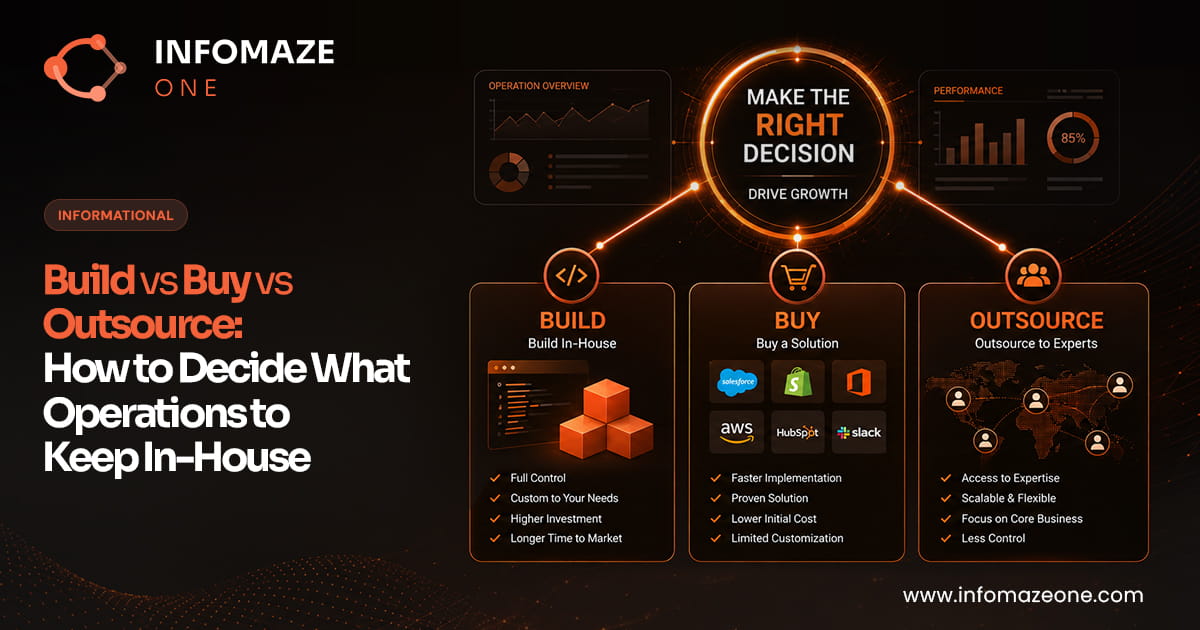
Build (in-house)
You hire people, potentially acquire tools, and operate the function with your own resources. You have full control over how it works, who does it and how it integrates with the rest of the business. The costs are direct and visible — headcount, benefits, management overhead, office space, technology. The risks are also yours: hiring risk, retention risk, knowledge concentration risk (what happens when the one person who knows how this works leaves?).
Buy (technology/software)
You license software that enables or partially automates the function, operating it with your team. The technology cost replaces some headcount cost, but your team still operates the system. You benefit from the vendor’s ongoing investment in the product. You take on vendor risk (pricing, product direction, stability) and still need internal capacity to operate and maintain the system.
Outsource / managed service
You engage a third party to operate the function on your behalf, to defined outputs and SLAs. Your internal involvement is reduced to oversight, exception escalation and relationship management. Costs are typically more variable than in-house (scaling with usage rather than being fixed headcount). You take on vendor risk but lose less internal capacity to execution work.
The Four Questions That Determine the Right Answer
1. Is this a source of competitive advantage?
The most important question in any build vs buy vs outsource decision. If the way you perform this function is genuinely a source of competitive differentiation — if customers choose you partly because of how you do this, or if doing it in-house creates proprietary capabilities that competitors can’t replicate — then the case for keeping it in-house is strong.
The honest answer for most operational functions is no. Invoice processing is not a source of competitive advantage. Neither is HR administration, IT helpdesk management, or compliance documentation. These are necessary functions, but customers don’t choose suppliers based on how good their AP process is. The competitive advantage for most businesses is in product, service, relationships and expertise — not in the operational functions that support the delivery of those things.
2. Does it require deep, proprietary knowledge?
Some functions require knowledge so specific to your business — your product, your customers, your culture, your strategic direction — that an external party could not acquire that knowledge without being deeply embedded in your organisation. These functions typically benefit from in-house ownership because the knowledge gap between internal and external is structural.
Most operational functions don’t have this characteristic. The knowledge required to process your invoices is the knowledge of invoice processing — a generalizable skill — plus some configuration to your specific systems and vendor base. That knowledge transfer is achievable in a weeks-long onboarding, not a multi-year embedded relationship.
3. What is the cost structure comparison?
A rigorous cost comparison between in-house and outsourced operation requires accounting for total costs, not just direct costs. In-house costs include: salary and benefits, employer taxes, recruitment cost (typically £3,000–£8,000 per hire), training cost, management overhead, technology infrastructure, office space, holiday and sick cover. Outsourced costs are typically more visible — a monthly fee — but require adjustment for the management time still needed for oversight.
The comparison often surprises: in-house looks cheaper until the full cost is calculated, and outsourced looks more expensive until the quality and scalability benefits are factored in.
4. What is the scalability requirement?
How much will the volume of this function need to change over the next 12–24 months? In-house operations scale by hiring (slow, costly) or by shedding headcount during downturns (culturally difficult). Outsourced operations typically scale more easily in both directions — volume increases handled by the provider, decreases reflected in lower fees without headcount decisions.
If your business is growing fast or has significant seasonal volume variation, the flexibility premium of outsourcing has real value beyond the headline cost comparison.
Common Mistakes in These Decisions
Treating “we’ve always done it this way” as a rationale
The historical fact that a function has always been in-house is not an argument for it remaining in-house. It’s an argument for revisiting the decision deliberately rather than letting inertia make it by default.
Comparing in-house cost to outsourced cost without adjusting for quality
If your in-house AP process has a 3% error rate and an outsourced solution has a 0.5% error rate, a simple cost comparison misses the value of the quality improvement. Error correction, duplicate payments, late payment penalties and write-offs are costs of poor-quality in-house operations that don’t appear in the headcount budget but are real.
Treating outsourcing as permanent
The decision to outsource a function today doesn’t mean owning it externally forever. Business circumstances change, technology capabilities improve, and the right answer at 200 employees may be different at 1,000. Outsourcing agreements should be structured to allow return to in-house operation without excessive switching costs if circumstances change.
Choosing “buy” when the problem is process, not technology
Software doesn’t fix a broken process — it automates a broken process faster. If the fundamental workflow for a function is poorly designed, adding technology before fixing the process produces expensive inefficiency. The decision to buy software should be preceded by a process audit that confirms the workflow is sound.
“The question to ask is not ‘should we keep this in-house?’ It’s ‘if we were designing this function from scratch today, knowing what we know about available options, how would we structure it?'”
Applying the Framework
For each significant operational function in your business, apply the four questions:
- Is this a source of competitive advantage? (If yes, strong case for in-house)
- Does it require proprietary knowledge that can’t be transferred? (If yes, lean in-house)
- What is the full cost comparison including quality differences? (Calculate honestly)
- What scalability is required? (Variable demand favours outsourcing)
For most back-office operations — AP, AR, compliance, HR admin, IT helpdesk, document processing — the honest answers point toward outsourcing: not a competitive advantage, not requiring proprietary knowledge, competitive on full cost comparison, better scalability. The functions that typically score differently are those genuinely embedded in how the business competes: product development, customer relationships, brand, strategy.
Our free AI Audit helps you apply this framework to your specific operational functions — assessing which operations are candidates for OaaS, what the cost comparison looks like, and what the transition path would be. No commitment required. Book your free AI Audit →
Ready to automate your operations?
Book a free AI Audit — 60 minutes, no obligation, realistic ROI estimate.