
Three Models, One Problem
Operational overhead is a problem that every growing business faces. As transaction volumes grow, the administrative work required to support the business scales with it — invoices to process, data to enter, compliance to maintain, queries to handle. Finding efficient ways to manage that overhead without proportional headcount growth is a perennial challenge.
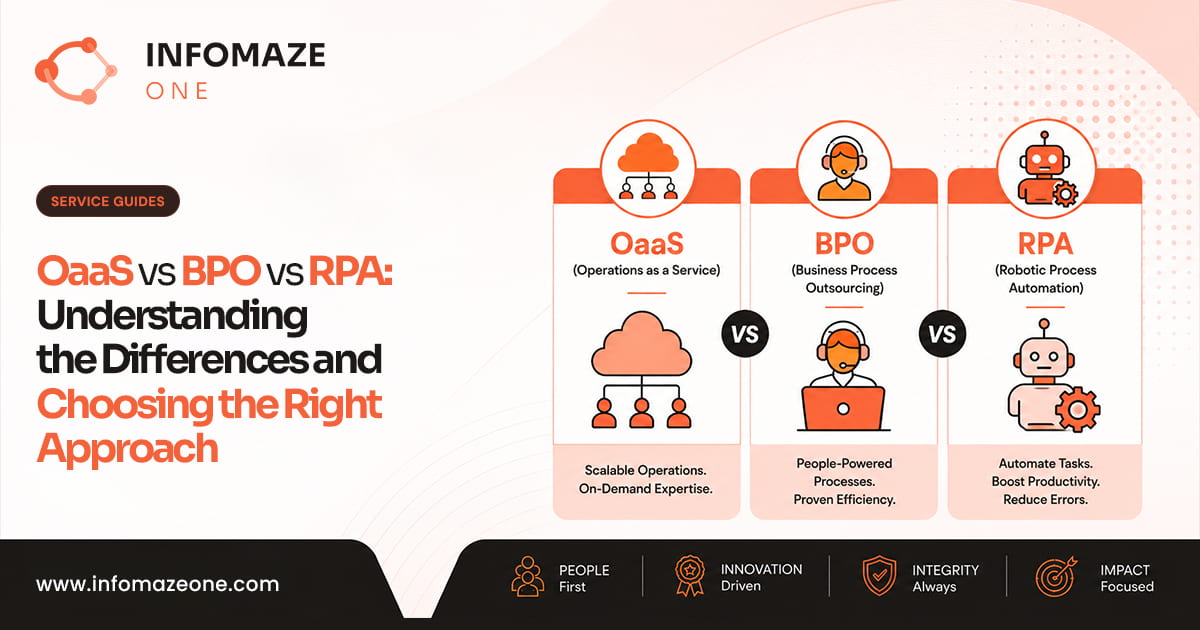
Three models have emerged as the dominant approaches to solving it: Business Process Outsourcing (BPO), Robotic Process Automation (RPA), and Operations-as-a-Service (OaaS). These terms are sometimes used interchangeably in vendor marketing, but they represent meaningfully different approaches with different cost structures, capabilities and appropriate use cases.
Understanding the differences is important for making the right choice — because choosing the wrong model for a specific situation is a reliable path to disappointing results and wasted investment.
Business Process Outsourcing (BPO)
What it is
Traditional BPO involves contracting the operation of a specific business process to a third-party provider. The provider typically operates the process using offshore teams in lower-cost locations — the Philippines, India, Eastern Europe — where the labour cost differential creates the economic case for outsourcing.
BPO has been the dominant model for back-office outsourcing since the 1990s. In its mature form, it’s a well-understood model with established pricing, contract structures and performance management frameworks.
Where it works well
BPO works well for high-volume, labour-intensive processes where the quality requirements are clear, the process is well-defined and the primary value driver is labour cost reduction. Large-scale data entry, customer service operations with defined scripts, transaction processing with clear rules — these are the processes that suit traditional BPO.
Where it struggles
Traditional BPO has several structural limitations that have become more visible as technology has advanced. Quality variability is inherent: the model depends on human operators whose performance varies, and managing quality at scale requires supervisory overhead that erodes the cost advantage. Scaling up requires hiring, which is slow and adds management complexity. Scaling down is difficult without contract renegotiation.
Knowledge transfer is also challenging. BPO operators learn your specific business processes but that knowledge concentrates in specific individuals — when key operatives leave (which happens frequently in offshore environments), quality typically dips while replacements are trained.
Robotic Process Automation (RPA)
What it is
RPA uses software bots to automate repetitive, rule-based tasks by mimicking human interaction with computer systems — clicking buttons, reading screens, copying and pasting data, filling forms. Unlike BPO, RPA replaces human operators with software; unlike traditional enterprise integration, RPA works at the user interface level without requiring system changes or API access.
RPA vendors like UiPath, Automation Anywhere and Blue Prism have built substantial businesses on the proposition that this kind of automation is accessible to business teams rather than requiring deep technical skills to implement.
Where it works well
RPA excels when a process involves navigating legacy systems or applications without APIs, where the inputs are structured and consistent, and where the process rules are clearly defined and stable. Data migration between legacy systems, form filling in regulatory portals, scheduled report generation from systems without export functionality — these are RPA’s strongest use cases.
Where it struggles
RPA has a fundamental brittleness problem: bots operate by referencing specific elements of a user interface, and when that interface changes — which happens constantly in cloud software through updates and redesigns — bots break and require maintenance. Organisations with large RPA deployments often find that a significant proportion of their maintenance budget is consumed by updating bots after system changes.
RPA also requires ongoing management: monitoring to detect failures, maintenance to fix broken bots, and technical expertise to develop new automations. The total cost of ownership for RPA at any significant scale typically exceeds what buyers anticipate at the point of initial investment.
Operations-as-a-Service (OaaS)
What it is
OaaS is a managed service model that combines AI-powered automation with expert human oversight to deliver operational functions end to end. The provider is responsible for both the technology and the operations — designing the automation, operating it, handling exceptions, maintaining quality and continuously improving performance. The client receives operational outputs (processed invoices, clean CRM data, resolved support tickets) rather than managing a process or a technology platform.
OaaS is a relatively recent category, enabled by the maturation of AI capabilities that make it possible to process unstructured documents and variable inputs at the accuracy levels required for business operations.
Where it works well
OaaS works best for operations that involve document-intensive or data-intensive workflows at meaningful volume, where the client wants to consume the operational output without managing the process, and where quality consistency and scalability are important. AP automation, document data extraction, compliance documentation management, IT helpdesk operations, CRM data management — these are the natural home of OaaS.
Where it struggles
OaaS requires trust in the provider: you’re handing operational responsibility to a third party and depending on their quality, reliability and security credentials. This makes provider selection critical and makes ISO certifications, reference clients and transparent reporting more important than in a pure software purchase. OaaS also has higher minimum viable scale than RPA — the setup costs of an OaaS engagement are justified by ongoing volume, so very low-volume processes may not justify the engagement.
Head-to-Head Comparison
Across six key dimensions, the three models compare as follows:
-
Cost structure. BPO:
primarily variable (per-FTE or per-transaction), with management overhead. RPA: high upfront development cost, ongoing maintenance cost, internal management. OaaS: typically per-transaction or monthly subscription, with predictable costs and no internal management overhead.
-
Quality. BPO:
variable, dependent on operator quality and attrition management. RPA: consistent for defined cases, breaks on exceptions and system changes. OaaS: high and consistent, with AI accuracy plus human validation.
-
Scalability. BPO:
scales by hiring, which is slow and adds management complexity. RPA: scales within bot capacity, but adding new process coverage requires development. OaaS: scales easily with volume without proportional cost increase.
-
Implementation time. BPO:
4–12 weeks (hiring and training). RPA: 8–24 weeks (development and testing). OaaS: 2–4 weeks (configuration and integration).
-
Internal resource required. BPO:
management oversight and SLA monitoring. RPA: technical team for development and maintenance. OaaS: account management and exception review — minimal.
-
Handles unstructured inputs. BPO:
yes (human judgment). RPA: no (requires consistent, structured inputs). OaaS: yes (AI + human).
Which to Choose
The decision framework is relatively clear once the characteristics of each model are understood:
Choose traditional BPO when you need very high volume handled by humans with specific cultural or language requirements, where AI accuracy isn’t yet sufficient (genuinely novel judgment-based tasks), or where regulatory requirements mandate human decision-making at every step.
Choose RPA when you need to automate interactions with legacy systems that have no APIs, the process inputs are consistent and highly structured, and you have the internal technical capacity to build and maintain the bots reliably.
Choose OaaS when you want the operational outcome without the internal management overhead, the process involves document processing or variable unstructured inputs, you need to be live quickly, and quality consistency and scalability are priorities.
“For most mid-market businesses, OaaS produces better results than BPO at comparable or lower cost, and better results than RPA with significantly lower internal management burden. The trade-off is provider dependency — which is why provider quality matters enormously.”
Infomaze One delivers OaaS — AI-powered operations with expert human oversight, managed by us, live in 2 weeks. Our free AI Audit compares the OaaS model against your current approach and the alternatives for your specific operations, with concrete numbers. Book your free AI Audit →
The Hybrid Approach
In practice, many businesses use elements of all three models across different processes. A large enterprise might use BPO for high-volume customer service in specific languages, RPA for legacy system integrations that don’t justify API development, and OaaS for document-intensive AP and compliance operations where AI accuracy and scalability matter most.
The key is matching the model to the specific characteristics of each process rather than applying one model universally. The businesses that get operational efficiency right typically have a portfolio approach — using each model where it’s strongest, and managing the portfolio at a level where each component is fit for purpose.
Ready to automate your operations?
Book a free AI Audit — 60 minutes, no obligation, realistic ROI estimate.