
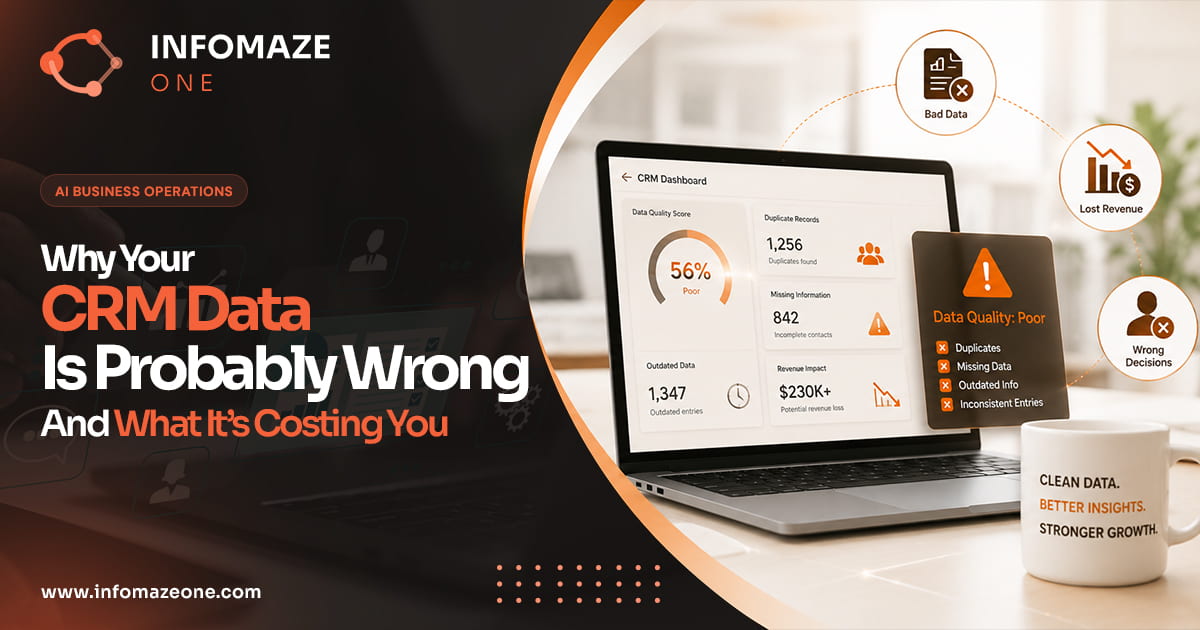
The Dirty Secret About CRM Data
Ask any sales director whether they trust their CRM data and you’ll get one of two answers: a laugh, or a pause followed by a reluctant “mostly.” Ask the same question of their ops or IT team and the answer is usually clearer: no.
CRM data quality is one of those problems every business knows it has but few ever fix properly. The reason is structural: the same people who are supposed to keep data clean are the ones who are under the most pressure to close deals, answer queries and move fast. Data hygiene is always the thing that gets deprioritised when something more urgent is in the queue — which is always.
The result is a CRM that starts as a reliable record of your business relationships and gradually degrades into a mix of accurate data, stale data, duplicate records and data that was never entered correctly in the first place.
How Bad Is It Actually?
The research on CRM data quality is consistently sobering. Gartner estimates that poor data quality costs organisations an average of $12.9 million per year — and that figure was for large enterprises. For smaller businesses the absolute numbers are lower, but the proportional impact on revenue is just as significant.
More specifically:
- Studies suggest that CRM data decays at a rate of 22–30% per year as contacts change roles, companies merge, phone numbers change and email addresses become invalid
- The average CRM contains a duplicate rate of 10–30% — meaning one in ten to one in three records is a duplicate of another
- Salespeople spend an average of 27% of their working week on data entry and administrative CRM tasks
- Marketing campaigns sent to inaccurate data achieve open rates 15–25% lower than campaigns sent to verified contacts
The Five Root Causes
CRM data quality problems are predictable and come from a small set of recurring causes:
1. Manual entry at the point of creation
When a salesperson creates a contact record after a call, they enter what they remember. Names are misspelled. Company names aren’t standardised (is it “Ltd”, “Limited” or “Ltd.”?). Phone numbers are entered in different formats. Email addresses contain typos that are never caught because nobody validates them at entry.
2. No ownership after creation
Records created during a sales process often aren’t updated after the deal closes — or after the contact moves on. A record that was accurate at creation can be wrong within 12 months without anyone noticing, because nobody is assigned the job of keeping it current.
3. Data from multiple sources without deduplication
When your CRM receives data from your website, your marketing platform, your accounting system and manual entries, you get duplicates. The same person appears three times with slightly different name spellings, different email formats and different phone numbers. No downstream system knows which one is canonical.
4. Stale pipeline data
Deals that have died are left as “open” for months because closing them feels like admitting failure. Contacts who have left companies remain associated with the wrong organisation. Opportunities sit at the wrong stage indefinitely.
5. No ongoing hygiene process
Even if data is entered correctly, without a recurring cleaning process, decay is inevitable. The companies that have clean CRM data tend to have made a deliberate operational decision to treat data hygiene as a continuous function — not a one-off project.
What Inaccurate CRM Data Actually Costs
The cost of poor CRM data is diffuse, which is why it rarely gets prioritised. It doesn’t appear as a line item on a budget. Instead it shows up as:
Revenue leakage. Deals that could be re-engaged but aren’t because the contact information is wrong. Renewals that lapse because the right person was never in the system. Upsell opportunities missed because the CRM doesn’t accurately reflect the customer’s current situation.
Wasted marketing spend. Email campaigns sent to invalid addresses, wrong job titles, or contacts who left the target company. Paid retargeting audiences polluted with duplicates and irrelevant records. Account-based marketing campaigns targeting the wrong decision-maker because the CRM shows the wrong person in the role.
Sales inefficiency. Reps spending time researching contacts that should already be in the system. Double-contact incidents where two reps reach out to the same prospect because both records exist. Time wasted preparing for calls using the wrong company context.
Poor decision-making. Pipeline forecasting that’s wrong because the data it’s based on is wrong. Territory planning built on inaccurate segmentation. Customer success metrics that don’t reflect actual customer health.
“Clean data isn’t a technical problem. It’s an operational problem — and it needs an operational solution, not a software upgrade.”
Fixing It Properly
The temptation is to treat CRM data quality as a project: a one-off clean-up effort followed by better practices going forward. This almost never works. A clean-up without a continuous maintenance process is a temporary fix; within 12–18 months you’re back where you started.
The right approach treats data quality as a continuous operational function:
Deduplication at ingestion
Every new record entering the CRM — from any source — is checked against existing records before creation. Duplicates are flagged and merged. This stops the problem at the source rather than cleaning it up after the fact.
Enrichment against verified sources
Contact records enriched with validated data: company details verified against public registries, email addresses validated, phone numbers formatted consistently, LinkedIn profiles linked where available.
Recurring cleansing cycles
A monthly or quarterly process of identifying and resolving stale records: contacts who haven’t been engaged, deals that haven’t moved, companies that have merged or closed. Not done manually by your sales team — done systematically by an ops function whose job is to keep the data accurate.
Synchronisation governance
When your CRM talks to your accounting system, your marketing platform and your customer success tool, data conflicts arise. A governance process defines which system is the master record for each field and how conflicts are resolved.
Our CRM & ERP Operations service provides ongoing data hygiene as a managed function — deduplication, enrichment, pipeline maintenance and system sync, handled by our team on your behalf. Your CRM stays accurate without your sales team ever touching a data quality task.
The Business Case for Prioritising This
The ROI of clean CRM data is real but requires measuring the right things. The headline metric isn’t “we reduced duplicate records by 40%” — it’s “we increased pipeline conversion by 8% because our sales team was working from accurate contact data” or “our email marketing ROI improved by 23% because we stopped sending to bad addresses.”
Clean data is a foundation. The AI tools, the workflow automation, the personalisation — they all depend on the data being correct. You can build a sophisticated technology stack on top of a poor data layer, but you’ll always be fighting a tide of bad inputs producing bad outputs.
Getting your CRM data right isn’t glamorous. But it’s one of the highest-leverage operational improvements a sales-led or customer-facing business can make, and it’s one that compounds over time rather than depreciating like most technology investments.
Ready to automate your operations?
Book a free AI Audit — 60 minutes, no obligation, realistic ROI estimate.