
The Problem With Documents
Every day, your business receives hundreds of documents. Invoices from suppliers. Purchase orders. Delivery notes. Customer forms. Contracts. Compliance certificates. HR paperwork. Each one contains data your systems need — and in most businesses, someone on your team is manually reading them, typing the information in, and hoping they don’t make a mistake.
That manual process is slow, expensive and error-prone. The average data entry error rate for human operators sits at 1–4%, which sounds small until you realise it means one in every 25 to 100 documents your team processes contains incorrect data. At any scale, that adds up fast — in wasted time, in wrong decisions made from bad data, and in downstream operational problems.
Intelligent Document Processing (IDP) was built to solve exactly this. And in 2025, it’s mature enough that businesses of any size can deploy it without enterprise-level IT budgets.
What Is Intelligent Document Processing?
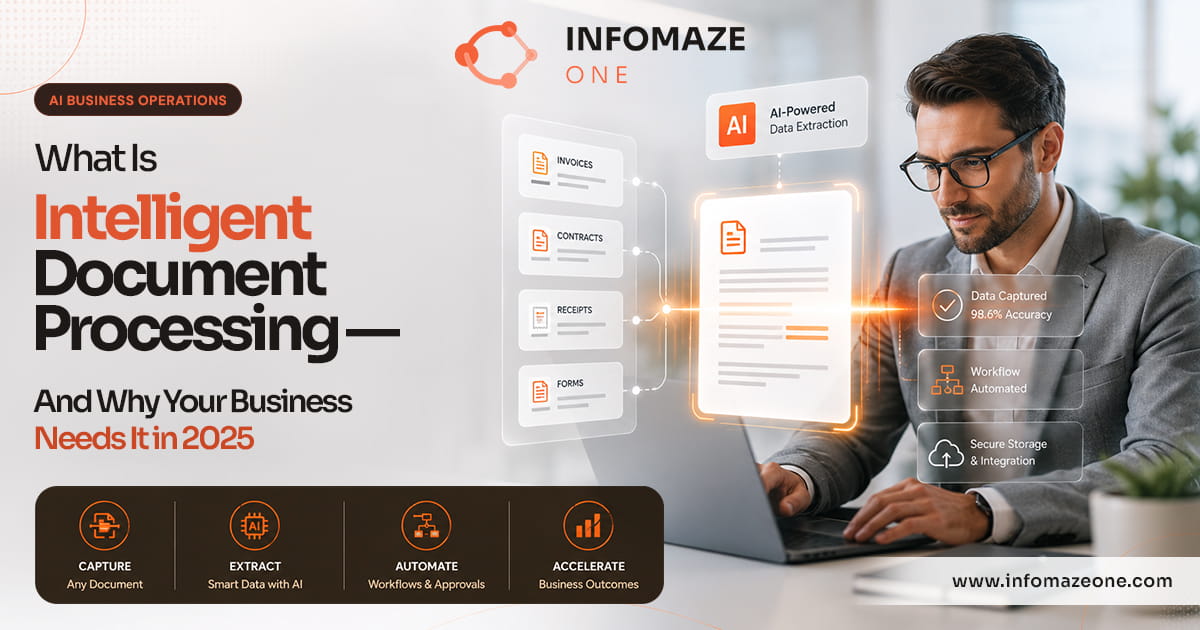
Intelligent Document Processing is the use of AI, machine learning and natural language processing to automatically capture, extract, classify and route information from documents — regardless of their format, layout or content structure.
Where older systems relied on fixed-template OCR (optical character recognition) that broke the moment a supplier changed their invoice layout, modern IDP systems understand document intent. They know that the number next to “Total Amount Due” on an invoice is the amount payable, even if it appears in a different position, uses a different label, or comes in a completely different visual format than the last invoice from the same supplier.
The key capabilities in a modern IDP system are:
- Ingestion — accepting documents from any channel: email attachments, scanned PDFs, portal uploads, EDI feeds, WhatsApp images, physical post scans
- Classification — identifying what type of document it is (invoice, purchase order, contract, form) before any extraction begins
- Extraction — pulling out specific data fields based on document type: for an invoice, that means vendor name, invoice number, line items, VAT, due date and so on
- Validation — cross-checking extracted data against rules, lookups or other records (for example, matching an invoice amount to an existing purchase order)
- Routing — sending the structured data to the right system, workflow or person
How IDP Differs From Basic OCR
Traditional OCR reads text from images and PDFs. It doesn’t understand context. If a supplier moves their invoice number from the top-right to the top-left of their invoice template, traditional OCR extracts whatever text is in the position it was configured to look at — or fails entirely.
IDP uses large language models and trained classification systems to understand documents the way a human would. It looks for meaning, not just text at coordinates. It handles:
- Handwritten documents and mixed print/handwrite formats
- Tables, line items and multi-page documents
- Documents in multiple languages
- Inconsistent formatting across suppliers or sources
- Low-quality scans and photos taken on mobile devices
The practical result is a system that processes your real document base accurately — not just a curated set of perfectly formatted test documents.
Where IDP Creates the Most Value
IDP delivers the highest ROI in departments and workflows that handle large volumes of incoming documents:
Accounts Payable
The most common use case. Invoices arrive by email, post and portal. IDP extracts all line-level data, validates it against purchase orders and goods receipt notes, and routes it for approval — without a human touching it unless there’s an exception. Processing time drops from 30–45 minutes per invoice to under 60 seconds.
Logistics and Freight
Bills of lading, customs entries, carrier invoices, proof of delivery documents — all processed automatically. Each shipment generates 8–12 documents; IDP ensures all of them are captured, extracted and routed to the right system without ops staff manually handling them.
HR and Onboarding
New starter forms, right-to-work documents, certificates, qualification evidence — IDP reads them, extracts the relevant information and routes it to your HR system. Onboarding that took two days of admin now takes 30 minutes.
Legal and Compliance
Contract data extraction, compliance certificate monitoring, regulatory return preparation — IDP keeps your compliance records current automatically, rather than relying on someone remembering to update a spreadsheet.
“The question isn’t whether IDP is accurate enough — it is. The question is whether your business can afford the cost and error rate of not using it.”
The Human in the Loop
A common concern about IDP is accuracy. What happens when the AI gets it wrong?
The answer is exceptions handling. Well-designed IDP systems flag documents where confidence is below a threshold and route them for human review. This means your team reviews the 2–5% of documents that need attention — not all 100%. The rest are processed automatically with a confidence level that, at 99%+, exceeds what most human data entry operators achieve consistently.
At Infomaze One, our human validation layer is baked into every engagement. Our ops team reviews exceptions, handles edge cases, and trains the AI on your specific document base continuously. The system improves over time — by month three, the volume requiring human review is typically lower than month one.
Getting Started With IDP
For most businesses, the right starting point is the highest-volume, most repetitive document workflow — almost always accounts payable or supplier invoice processing.
A practical first step is to audit your current document volumes: how many documents of each type arrive per month, what data fields you extract from each, and what your current processing cost and error rate is. That baseline makes the ROI calculation straightforward.
The implementation timeline for a well-scoped IDP engagement is typically 2–4 weeks from signed agreement to live operations — not months. The data doesn’t need to be clean before you start; the AI learns from your actual document base.
Our Data Operations service provides fully managed IDP — we handle the technology, the training and the ongoing ops, so you don’t need to hire a data science team or manage software. You send us documents; we send back clean, structured data in your systems.
The Bottom Line
Intelligent Document Processing is no longer experimental technology reserved for enterprise budgets. It’s a practical, deployable capability that businesses processing more than 50 documents per month can use to eliminate manual data entry, reduce errors and free their teams from work that adds no strategic value.
The businesses using it aren’t just saving money — they’re processing faster, making fewer mistakes, and giving their operations teams back the time to do work that actually matters. The businesses still doing it manually are paying a cost they don’t always see clearly because it’s distributed across dozens of people doing a little bit of unnecessary admin every day.
In 2025, that’s a competitive disadvantage you don’t need to carry.
Ready to automate your operations?
Book a free AI Audit — 60 minutes, no obligation, realistic ROI estimate.