
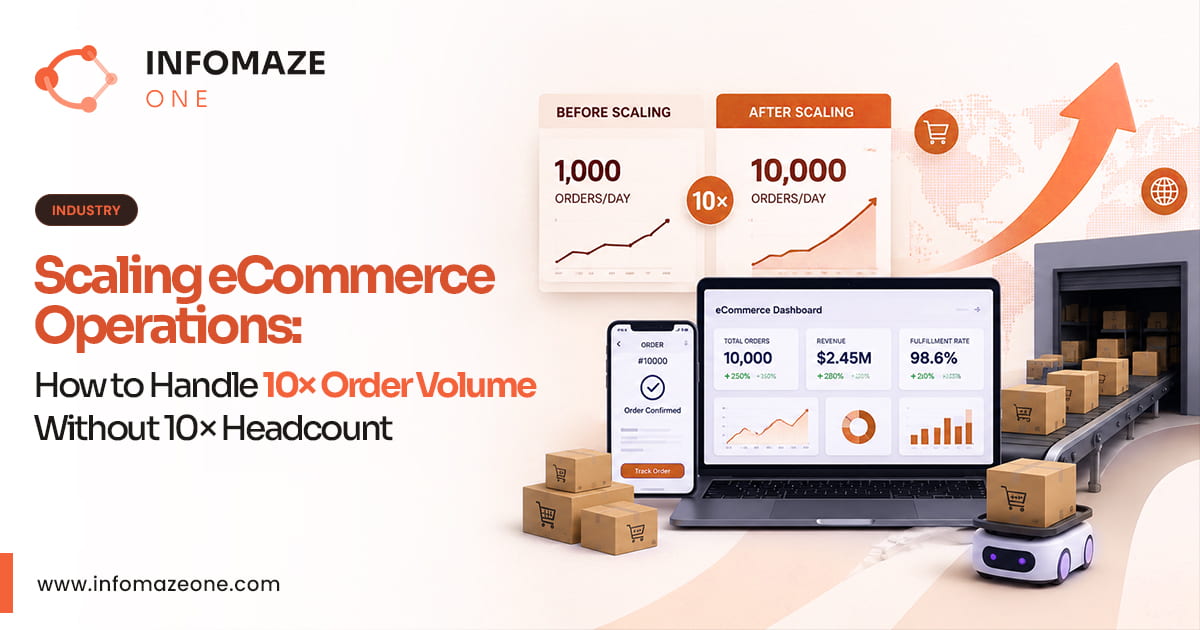
The eCommerce Operations Ceiling
Every growing eCommerce business hits an operations ceiling. It usually happens somewhere between 100 and 500 orders per day — the point where the processes that worked at smaller scale start to buckle. The fulfilment team can’t keep up. Customer service tickets are piling up. Product data is falling behind. Returns are taking too long. And the answer that’s been working — hire another person — is getting expensive and isn’t actually solving the underlying problem.
The ceiling isn’t caused by lack of effort or capable people. It’s caused by a fundamental mismatch between the volume of operational tasks and the processing capacity of a manually-operated workflow. At 50 orders a day, manual processes work. At 500 orders a day, the same processes require five times the headcount — or a fundamentally different approach to how operations are run.
The brands that scale successfully beyond that ceiling don’t do it by hiring proportionally. They do it by redesigning their operational model so that the vast majority of routine tasks run automatically, and human attention is reserved for the decisions, exceptions and relationships that actually require it.
Where eCommerce Ops Time Actually Goes
To understand how to scale operations without proportional headcount growth, it’s useful to map where ops time is currently being spent. For most eCommerce businesses in the 100–500 orders/day range, the distribution looks something like this:
Order processing and fulfilment coordination (30–40% of ops time). Processing new orders into the fulfilment system, handling address validations, dealing with out-of-stock situations, coordinating with warehouse or 3PL, updating tracking information, managing courier relationships.
Customer service (25–35%). Inbound queries about order status, delivery updates, product questions, return requests, complaints, refund processing. The volume scales directly with order volume — more orders means more queries, and more of everything that goes wrong.
Product data management (15–20%). Creating new SKUs, updating product descriptions, adjusting prices, managing inventory levels, updating marketplace listings, processing supplier updates to specifications or images.
Returns processing (10–15%). Handling return requests, issuing authorisations, processing refunds, updating inventory when returns arrive, managing the carrier relationship for return labels.
The pattern that emerges is clear: most ops time is consumed by high-volume, repetitive tasks that follow predictable rules and don’t require expert judgment for the vast majority of cases. That’s the profile of tasks that can be automated.
Building the Operational Foundation for Scale
Order processing automation
The order-to-fulfilment workflow is the highest-volume, most repeatable process in any eCommerce operation. Orders arriving from Shopify, Amazon, eBay and other channels are validated (address, fraud check, stock availability), routed to the appropriate fulfilment location or 3PL, and tracking information returned to the customer and updated in the order management system — without a human touching each one.
The ops team’s involvement in order processing shifts from execution (entering orders, checking stock, generating labels) to exception management (handling the 2–5% of orders that flag an issue requiring human judgment). The same team processes three times the volume because they’re spending their time on exceptions rather than routine processing.
Customer service systematisation
The majority of customer service volume in eCommerce follows predictable patterns: “Where is my order?”, “How do I return this?”, “Can I change my delivery address?”, “I received the wrong item.” These queries have scripted responses and clear resolution paths — they don’t require human judgment, they require accurate order data and the ability to execute a defined action.
AI-powered customer service triage can resolve a high proportion of these queries automatically: order status queries answered with real-time tracking data, return requests processed and labels issued automatically, standard complaints acknowledged and routed to the correct resolution workflow. Human agents handle the queries that are genuinely complex, emotionally charged, or outside the defined response patterns.
Returns management as a process, not a reaction
Returns in eCommerce are not an edge case — they’re a core operational workflow that scales directly with order volume. A 15% return rate on 500 daily orders means 75 returns per day to process. Without a systematic returns management process, this creates a growing backlog that extends resolution times, delays refunds, and damages customer satisfaction.
Automating returns — automatic authorisation within defined rules, automated refund initiation on receipt confirmation, automated inventory update when returned items are restocked — converts returns from a reactive, backlog-generating function into a systematic process with predictable timelines.
Product data as infrastructure
Product data quality is an invisible lever in eCommerce. When product titles, descriptions, attributes and images are accurate and complete across all channels, conversion rates are higher, return rates are lower (fewer “not as described” returns), and search visibility is better. When product data management is done manually and inconsistently, quality degrades over time as catalogue size grows.
A systematic product data management automation — clear workflows for new SKU creation, scheduled updates for existing products, consistent quality standards applied across the catalogue — is infrastructure that supports growth rather than constraining it.
“Scaling eCommerce isn’t about hiring faster. It’s about building operations that are structurally capable of handling 10× volume with the same core team — and then hiring strategically for growth, not catch-up.”
The Peak Season Test
The most revealing test of an eCommerce operation’s scalability is how it handles peak periods. Black Friday and Christmas in retail, key sale events in fashion, launch weeks in direct-to-consumer — every eCommerce business has peak periods where order volume multiples over normal levels, often for 2–4 weeks.
For businesses with manually-operated processes, peak periods mean emergency headcount, excessive overtime, errors under pressure, slow customer service response times, and a team that’s exhausted by the time volume returns to normal. For businesses with well-automated operations, peak periods are the proof of concept: the same workflows that handle 200 orders a day handle 600 orders a day without structural change, and the team’s role is to manage the small proportion of exceptions that peak volume generates.
The operational investment made during normal trading pays its biggest returns during peak. An operation that processed 3,400 orders over Black Friday weekend without a single fulfilment complaint didn’t achieve that through heroic effort — it achieved it through an operational model designed to handle that volume systematically.
Our eCommerce Operations service handles order processing, returns management, customer service ops and product data management as a fully managed function — scaling with your volume without requiring proportional headcount. See how it works →
Where to Start
For most eCommerce businesses at the operations ceiling, the highest-ROI starting point is customer service — specifically, building a systematic response framework for the top 10 query types by volume. Identifying those 10 types, designing response workflows for each, and automating the most routine ones typically reduces inbound volume requiring human handling by 50–70% immediately.
Order processing automation and returns management are typically phase two — they require deeper integration with the fulfilment and OMS systems but deliver the structural capacity that allows volume growth without headcount growth.
The key insight is that scaling eCommerce operations isn’t primarily a technology problem — it’s an operational design problem. The technology exists to automate most of what eCommerce ops teams currently do manually. The work is in designing the workflows, implementing the integrations, and building the exception-handling processes that make automated operations reliable enough to trust at scale.
Ready to automate your operations?
Book a free AI Audit — 60 minutes, no obligation, realistic ROI estimate.