
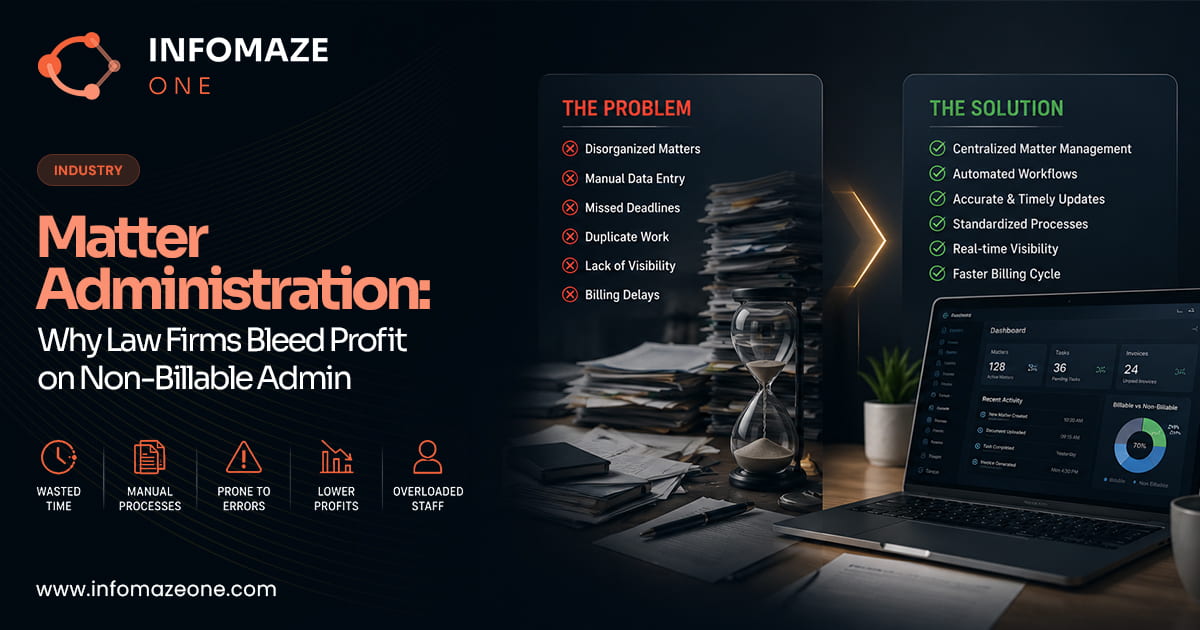
The Billable Hours Paradox
Law firms sell time. The fundamental commercial model is straightforward: fee earners bill hours to clients, the firm collects those billings, and the difference between billings and costs is the profit. In this model, any time a fee earner spends on work that can’t be billed to a client is a direct cost to the firm with no offsetting revenue.
The paradox is that in most law firms, fee earners — including partners whose hourly rate makes their non-billable time the most expensive of all — spend a significant proportion of their working week on exactly that: administrative work that cannot be billed and that adds no value that clients would recognise or pay for.
Research from the Legal Services Board and various law firm consultancies consistently finds that lawyers spend between 30–45% of their time on non-billable activities. Some of that is inevitable and legitimate — business development, team management, professional development. But a substantial portion — commonly estimated at 15–25% of total working time — is pure administrative overhead: matter opening, document management, billing preparation, compliance documentation, coordination tasks.
At a fully-loaded cost of £200+ per hour for a senior associate and £400+ for a partner, 15% of working time on avoidable admin is a substantial profit leak — and it compounds across a firm.
Where Admin Time Actually Goes
The administrative overhead in legal practice concentrates in predictable places:
Matter opening and file administration
Opening a new matter involves conflict checking, client onboarding, engagement letter preparation, CDD completion, file creation and system setup. Done properly, this is a 2–4 hour process per matter. Done in a busy fee earner’s calendar, it gets squeezed, corners get cut, and steps get missed — creating compliance risk and rework downstream.
Document management
Legal work is inherently document-intensive. Correspondence, court documents, contracts, counsel instructions, expert reports, bundles — each matter generates dozens or hundreds of documents that need to be filed, named consistently, indexed and retrievable. When fee earners manage their own document filing, it’s done inconsistently, often incompletely, and at significant cost per hour.
Time recording and billing administration
WIP reconciliation — reviewing unbilled time, writing off time that can’t be justified, preparing draft invoices and getting them approved — is one of the most time-consuming administrative tasks in practice management. Delayed billing cycles mean extended cash collection. Poor time recording discipline means billed hours don’t reflect the actual work done.
Court deadline and diary management
Limitation periods, filing deadlines, hearing dates, response windows — legal practice is deadline-driven in a way that carries professional negligence risk for any missed date. The systems for tracking these (practice management system diaries, personal calendars, sometimes spreadsheets) are often fragmented and dependent on individual discipline rather than systematic process.
Compliance documentation
AML checks, ongoing client monitoring, file review obligations, SRA compliance records — the regulatory documentation burden on law firms has grown substantially over the past decade, and most of it falls on fee earners or their secretaries rather than on a dedicated compliance function.
Why It Persists
The economic case for reducing administrative overhead in law firms is clear. The reason it persists is more complex:
Historic reliance on secretarial support. Law firms traditionally managed admin through secretaries and legal assistants. As that model has eroded under cost pressure, the work hasn’t been eliminated — it’s migrated upward to fee earners without anyone redesigning the process to reflect the reallocation.
Practice management systems that require fee earner input. Most practice management systems were designed to be operated by fee earners, not by a dedicated ops function. The system architecture assumes the lawyer creates the file, enters the time, prepares the bill. Extracting those tasks requires process redesign, not just delegation.
The perception that admin is “quick.” Individual administrative tasks feel brief — it’s only a few minutes to file that document, only 20 minutes to open that file. The problem isn’t any individual task; it’s the cumulative toll of 40–50 such tasks per week interrupting deep legal work, fragmenting concentration, and consuming disproportionate mental bandwidth relative to the time they take.
What managed legal operations Looks Like
The solution isn’t to hire more secretaries — the economics of that model are what created the problem in the first place. The solution is to design a legal ops function that uses AI and specialist ops staff to handle the administrative layer systematically, at a cost-per-task that’s a fraction of fee earner time.
In practice, this means:
Matter opening as a managed workflow. A new instruction triggers a structured process — conflict check run, CDD initiated, engagement letter generated from templates, file opened in the PMS, deadline calendar populated. The fee earner’s involvement is confined to reviewing and approving outputs, not doing the work.
Document management as a specialist function. All correspondence and documents filed, named consistently and indexed to matter by an ops team using your naming conventions and filing structure. The fee earner sends an email; it appears, correctly filed, in the matter record.
Deadline management as a systematic process. Court deadlines, limitation periods, filing windows and hearing dates entered into a centralised tracking system with automated alerts. Missed deadlines require a process failure, not just an individual lapse.
Billing administration separated from fee earning. WIP reviewed and draft invoices prepared by ops staff, presented to fee earners for review and approval rather than created from scratch by them.
“The highest-performing law firms have recognised that legal expertise and legal administration are different skills. Combining them in the same person is expensive, inefficient and — increasingly — unnecessary.”
The Partnership Economics
The firm-level arithmetic of reducing administrative overhead is compelling. A firm with 15 fee earners, each spending an average of 20% of their time on administrative tasks at an average fully-loaded cost of £120 per hour, has an annual administrative overhead of approximately £720,000 per year — time that could be billable, or at minimum, directed at business development rather than file management.
A managed legal operations function that handles the administrative layer for a fraction of that cost — typically £60,000–£100,000 per year for a 15-fee-earner firm — reduces the overhead substantially and converts a large proportion of that saved time into additional billings.
Our Legal Operations service provides fully managed matter admin — matter opening, document management, deadline tracking, billing admin and compliance documentation. NDA before any matter details are shared. Clients typically recover the equivalent of 2 fee earner weeks per month in previously administrative time. See how it works →
Getting Started
The right starting point for most firms is a time audit — not the kind that asks fee earners to estimate how much time they spend on admin (the answer is usually an underestimate), but a detailed diary analysis tracking how time is actually allocated across a two-week period.
The results of that audit are almost always more striking than the firm expects. The quantum of admin time is larger than intuition suggests, and the tasks involved are almost always ones that don’t require legal training to perform. That combination — high cost, low required skill — is the profile of a function that can be transformed by the right operational model.
Ready to automate your operations?
Book a free AI Audit — 60 minutes, no obligation, realistic ROI estimate.