
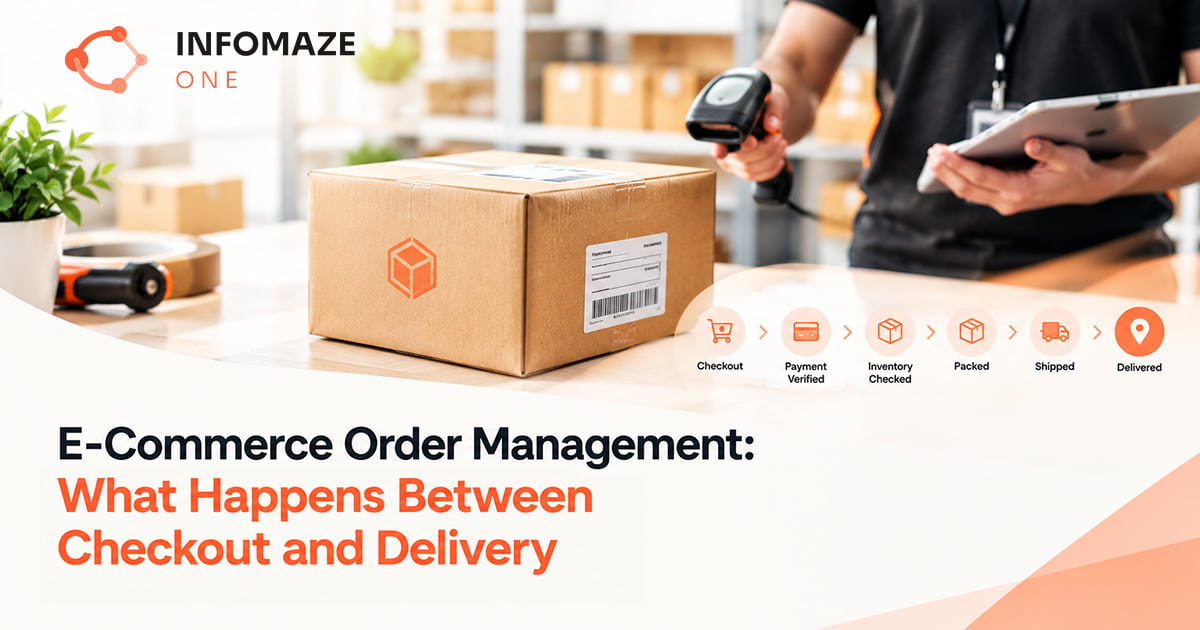
You click “Place order” and a confirmation email lands in your inbox. For you, that’s the end of it. For the retailer, it’s the start of about a dozen small jobs, and if one of them slips, you’re the person emailing support three days later asking where your parcel is.
Ecommerce order management is everything that happens between checkout and delivery: confirming the order, checking payment, address and stock, passing it to the warehouse or courier, sending tracking details, and dealing with whatever goes wrong on the way. A dependable order management process keeps those steps in sequence and keeps the customer informed. Plenty of growing stores choose to outsource e-commerce operations once order volume outgrows the team.
What happens after a customer clicks “buy”?
First comes intake. The order arrives from your store or marketplace and gets logged. Next comes validation: checking the delivery address, confirming stock availability and flagging payments that require further review Only after that does it move to fulfilment, where it’s routed to your warehouse or 3PL, a courier label is generated, and a tracking number is pushed back to your platform so the customer can follow along.
On a good day, none of this is visible. That’s the point.
What does a solid order management workflow look like?
Boring, mostly. A good order management workflow runs the same steps in the same order whether it’s a quiet Tuesday or the week of a sale. Every order gets the same checks, every handoff is recorded, and nobody has to remember what they did last time.
The trouble starts at the handoffs. Someone forgets to update stock, a label gets printed against an old address, a note from the customer never reaches the warehouse. Each gap is small. Add a few hundred orders a day and they become your most common support ticket.
Why do order exceptions cause most of the headaches?
Because they need a human brain. Order exceptions are the orders that don’t follow the script: an item that sold out after payment cleared, an address that doesn’t exist, a payment flagged for review, a courier delay, a parcel that arrives damaged. One in a hundred is no big deal. At volume, there’s always one waiting.
What helps is context. The person handling the exception should see the customer’s history, the order notes, and what’s already been tried. If it’s passed along with the full picture, it gets solved in one go. If it lands with nothing but an order number, it sits in an inbox while the customer waits.
How do order status updates keep customers calm?
Most “where is my order?” messages aren’t complaints. They’re people who haven’t heard anything and are starting to worry. Clear order status updates at confirmation, dispatch, delay and delivery answer the question before it’s asked, and tracking numbers that sync straight to the platform mean customers can check for themselves.
The messages that do come in are easier to deal with when the status is accurate and up to date. Simple queries about where an order is can be answered automatically, so your support team spends its time on the conversations that actually need a person
When does outsourcing e-commerce operations make sense?
Usually when the same few things keep going wrong. Returns drag on because orders always get priority. Product data falls behind. The owner is still answering delivery emails at night. Sales spikes turn into scrambles, because the process depends on whoever happens to be available.
One new hire can only cover so much. An outsourced team covers order management, returns, product data and customer queries at the same time, so nothing waits its turn. It also copes with spikes better. A well-defined order management process helps retailers handle seasonal sales spikes, coordinate fulfillment and resolve order issues without putting additional pressure on their internal teams.
That’s one reason Infomaze One can be a strong partner for e-commerce operations outsourcing. Order management, returns, product data and customer support run as one connected workflow rather than four separate jobs, and the team works inside the platforms you already use, including Shopify, WooCommerce, Amazon and eBay, so there’s no migration to sit through.
What should you check before choosing a partner?
If you decide to outsource e-commerce operations, a handful of questions will tell you a lot. Which platforms can they connect to? Who gets access to your order and customer data, and under what terms? How will you know what happened each day? How long until they’re live?
At Infomaze One, every engagement runs under NDA with role-based access limited to the systems the work needs. You get a daily operations summary before 9am covering order volumes, returns and ticket resolution. Most clients go live in around two weeks, and it starts with a free audit where the team maps your current process and shows you what to fix first.
Final thoughts
Customers only notice order management when it goes wrong. A clear workflow, a sensible way of handling exceptions and honest status updates will take you most of the way there. If you’re at the stage where your team can’t keep up without things slipping, a free audit with Infomaze One is a low-risk way to see where the gaps actually are.
Ready to automate your operations?
Book a free AI Audit — 60 minutes, no obligation, realistic ROI estimate.