
A customer clicks “buy,” waits for the box, opens it and sends it right back. For most online retailers, this isn’t the exception. It’s a routine part of running the business, and it’s often the most expensive part nobody budgets properly for. Shipping both ways, restocking, repackaging, and the lost sale itself all add up quietly until a quarterly report makes the number impossible to ignore.
Good returns management in e-commerce isn’t about eliminating returns entirely, that’s not realistic, and trying too hard to prevent them usually just annoys customers before they’ve even bought anything. It’s about building a process that keeps returns from bleeding money and time out of the business unnecessarily.
What does e-commerce returns management actually involve?
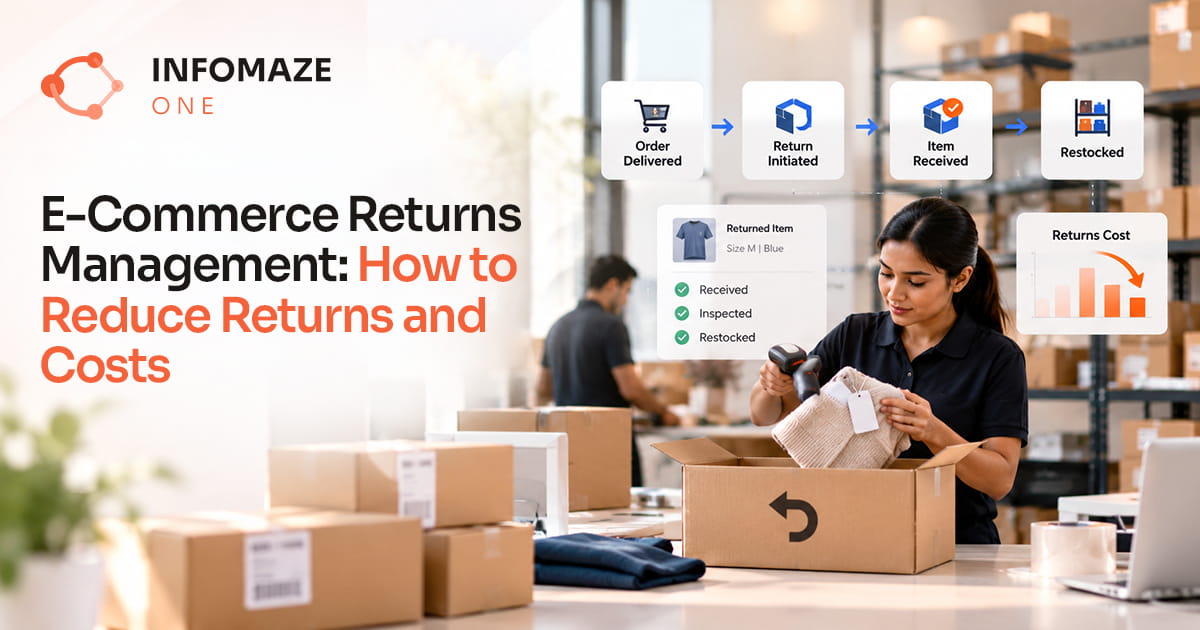
At its core, it covers everything that happens after a customer decides to send an item back: the return request, the shipping label, the inspection once the item arrives, the decision to restock or write it off, and the refund or exchange. A weak process makes each of those steps slower and more expensive than it needs to be. A strong one turns returns into a manageable, even predictable, part of e-commerce operations services.
Why do e-commerce returns cost more than businesses expect?
The sticker price on a returned item is rarely the real cost. There’s reverse shipping, the labor to inspect and process each return, repackaging, and for items that can’t be resold as a new markdown or a straight write-off. Add customer service time spent handling return questions, and a single return can quietly cost a business more than the margin it made on the original sale. That’s usually the moment a business starts actually looking into an e-commerce returns process instead of just absorbing the cost.
How to reduce e-commerce returns without hurting sales
Fix product listings before fixing the return process
A large share of returns trace back to one root cause: the product didn’t match what the customer expected. Vague sizing charts, low-quality photos, and descriptions that gloss over material or fit are the usual culprits. Clearer photos from multiple angles, honest sizing guidance, and specific descriptions cut down on returns before a single package ever ships, which is a cheaper fix than anything downstream.
Make the return policy easy to find and easy to understand
Confusing return policies don’t stop returns. They just push frustrated customers toward chargebacks or bad reviews instead. A return policy that’s short, visible before checkout, and doesn’t bury conditions in fine print builds trust and customers who trust a policy are, somewhat counterintuitively, often less likely to abuse it.
Use return data instead of guessing
Every return carries a reason code, if the business actually asks for one. Tracking why items come back wrong size, not as described, changed mind, damaged in transit, turns returns into a feedback loop instead of a dead cost. A spike in “wrong size” returns for one product usually points straight at a sizing chart that needs fixing, not a customer problem.
Speed up the inspection and restocking cycle
A returned item sitting in a warehouse corner for two weeks before anyone decides what to do with it is money doing nothing. The faster a business can inspect, decide, and either restock or resell an item, the less it loses to a slow cycle. This is one of the more overlooked e-commerce return solutions not preventing returns, but processing the ones that do happen far more efficiently.
Offer exchanges before refunds
Where it makes sense, prompting a size or color exchange instead of an automatic refund keeps revenue in the business instead of sending it straight back out the door. It also tends to leave the customer more satisfied than a flat refund, since they usually still get the product they actually wanted.
Where outsourcing fits into e-commerce returns management
Building all of this fast inspection, accurate data tracking, responsive customer communication, and a tight restocking cycle takes dedicated staff and systems most growing e-commerce businesses haven’t built yet. It’s exactly the kind of operational load that pulls attention away from marketing, product, and growth.
This is where Infomaze One fits in. Rather than treating returns as an afterthought squeezed between other tasks, Infomaze One manages the entire cycle processing, inspection, data tracking, and customer communication as a structured operation built specifically for online retailers. If reducing both return volume and the cost per return is the goal, talk to Infomaze One about setting up your returns operation.
Ready to automate your operations?
Book a free AI Audit — 60 minutes, no obligation, realistic ROI estimate.