
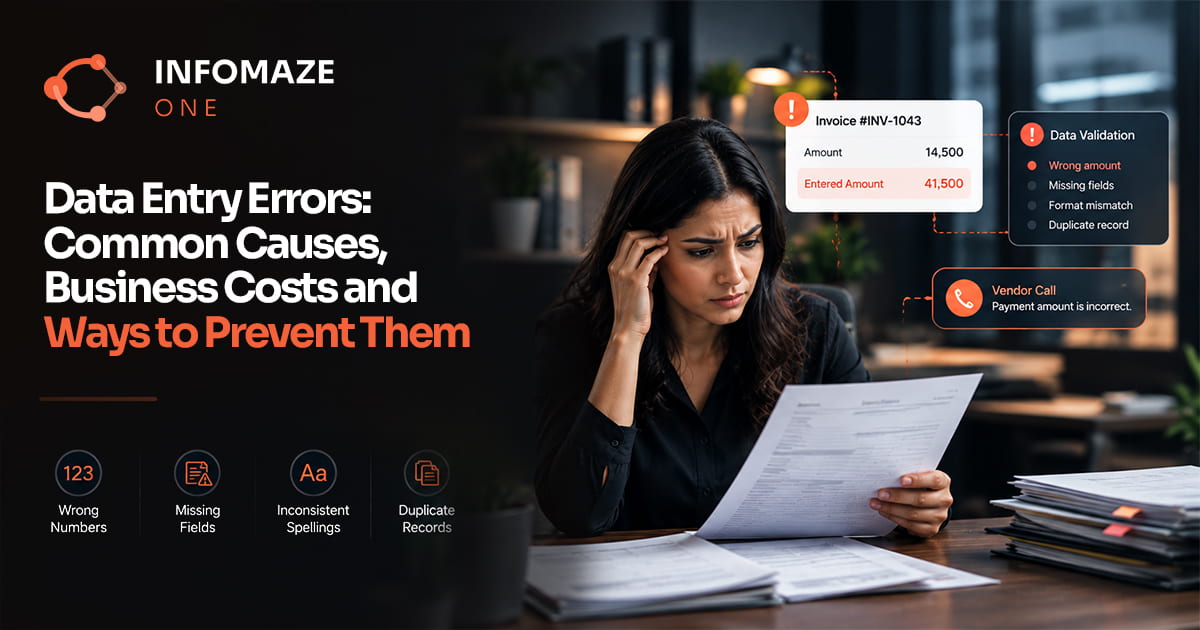
Picture a Monday morning in an accounts team. An invoice for 14,500 gets keyed in as 41,500. Nobody catches it until the vendor calls, polite but a little confused, about a payment that’s way off. Correcting the discrepancy requires coordination between the accounts team and the vendor, delaying the payment process and adding avoidable administrative work.
That’s a data entry error, and it’s a pretty typical one. In short, data entry errors are mistakes made when information is typed or moved into a system: wrong numbers, missing fields, inconsistent spellings, duplicate records. They usually come from repetitive manual work and a lack of checks. The usual fixes are data validation rules, cleaner formats, and, when volume gets heavy, outsourcing data entry to people who do it full time.
What are the most common data entry mistakes
Typos get the blame, but data entry mistakes are a wider family. Swapped digits. Blank fields. A date written as 03/04 by one person and 4 March by another. A customer saved as “Acme Ltd” in one place and “ACME Limited” in another, which gives you duplicate records that look like two different companies.
Here’s what makes them awkward: the system rarely complains. It takes the wrong value without a murmur, and the error sits there until someone pulls a report and the numbers look off.
Why do data entry errors happen
Honestly, mostly because the work is boring. Anyone keying in the same fields for hours loses focus, and when the backlog grows, speed starts to beat accuracy. The documents don’t help either. Blurry scans, handwritten forms, an email where the one detail you need is buried in paragraph four.
Turnover adds to it. A new person needs weeks to learn your formats and systems, and mistakes tend to spike during that window. And if nothing validates the data on the way in, a bad entry goes straight into the finance system or CRM.
What do data entry errors cost a business
The cost of correcting an error can extend beyond the immediate rework, affecting payment timelines, reporting accuracy, and employee productivity. A wrong figure on an invoice delays payment and starts an email thread. A bad record in a compliance file can turn into a headache at audit time. Duplicate records inflate your customer numbers, muddy your reports, and mean the same person gets three mailers.
And errors travel. One wrong entry gets copied into a report, synced to another tool, then used in a decision. Data accuracy slips quietly across the business. Resolving these issues also takes time away from accountants and coordinators who had better things to do.
How can you prevent data entry errors
Start where data enters. Make key fields required, check formats for dates and phone numbers, and use dropdowns instead of free text wherever you can. Simple data validation like this catches a surprising amount before it ever lands.
Next, pick one way of writing things, company names, addresses, currencies, and hold everyone to it. Schedule a duplicate check instead of waiting for a complaint. Put a second pair of eyes on anything that touches finance or compliance. And cut down on retyping where you can, because pulling data straight out of documents removes the step where most typos are born.
Is outsourcing data entry worth it
For businesses handling large or fluctuating volumes of records, outsourcing can improve consistency while reducing the pressure on internal teams. Accuracy becomes somebody’s whole job instead of a task squeezed between meetings. A dedicated team learns your document types, checks every batch, and doesn’t get pulled off to something else halfway through. You pay for the volume you actually send, so a slow month isn’t dead weight and a busy one doesn’t mean frantic hiring.
The bigger payoff is usually what happens to your own team. Once someone else is carrying the keying and checking, your accountants can get back to analysis and your coordinators can get back to talking to customers. It’s the work they were hired for in the first place.
If you’re weighing outsourced data management services, Infomaze One is a good place to start, mostly because of how the process works. A document comes in, AI pulls the data out at 99.2% accuracy, validation checks run, and anything that looks doubtful goes to a person before it gets anywhere near your CRM or finance tools. The typing is the easy part. It’s the checking around it that most in-house teams never find time to build.
What should you ask a data outsourcing partner
Four questions will tell you most of what you need to know. Who can see your files, and under what agreement? What gets checked before the data comes back to you? How quickly can they start, and is that in writing? And if you suddenly need to push through a migration or a seasonal rush, can they flex without a new contract?
Here’s how Infomaze One answers those. Projects run under NDA, and only the people on your account can see your files. Every batch passes layered checks before it’s returned. Most clients are live in about two weeks, and it starts with a free audit where the team traces how documents move through your business and flags what to fix first. If you’d rather begin with plain data entry and bring in automation later, you can, without changing providers.
Final thoughts
Each data entry error looks minor on its own. Together they turn into wrong invoices, messy records, and reports people stop trusting. Better validation and tidier habits will take you a long way. When volume outgrows what your team can check carefully, handing it to specialists who treat accuracy as the job is usually the quickest route back to clean data.
Ready to automate your operations?
Book a free AI Audit — 60 minutes, no obligation, realistic ROI estimate.