
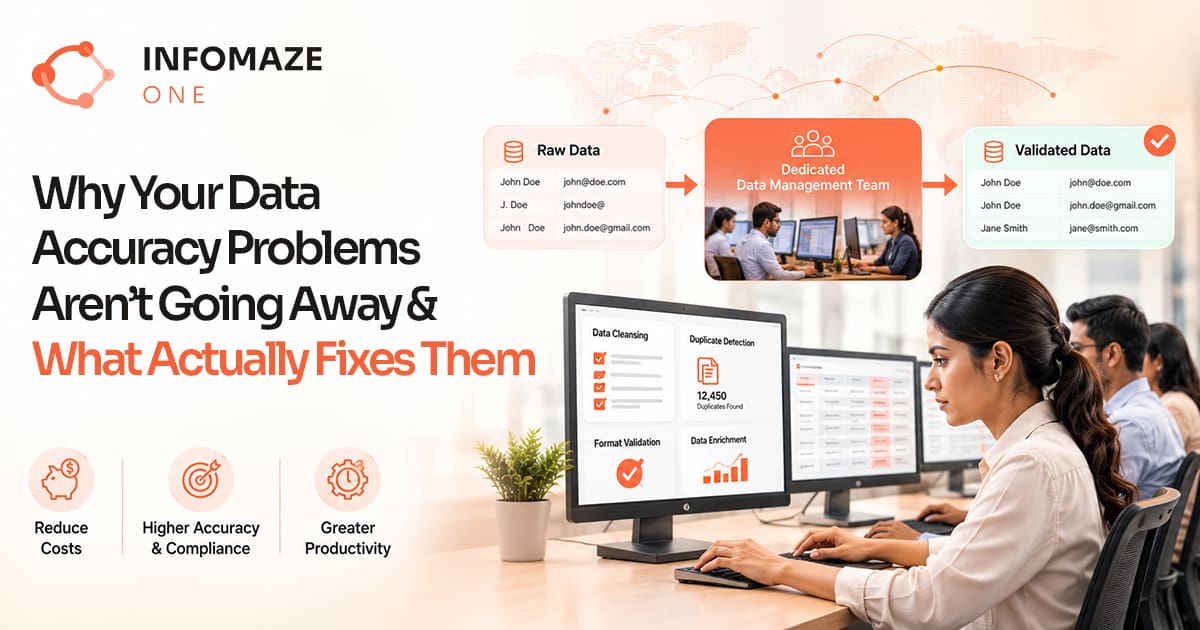
There’s a moment every business owner recognizes: you pull up a report, the numbers look off, and someone spends the next two hours digging through spreadsheets to figure out why. Usually the answer is boring – a customer’s name typed two different ways, an order entered twice, a field left blank because whoever was on data entry that day had four other things going on.
None of this is dramatic, but it adds up. Getting data accuracy and productivity working together, instead of treating them as separate problems, is exactly why more companies are handing their data work to a team that does it full-time.
How to Improve Data Accuracy in Your Business
Most employees handling data are also handling several other things – customer calls, order processing, admin work. Data entry gets squeezed into the gaps, and gaps don’t leave much room for careful checking.
There’s also a training gap companies rarely think about until it costs them. Nobody sits new hires down and teaches them how to spot a duplicate record or apply consistent formatting across systems. So when errors happen, it’s less about carelessness and more about asking untrained people to do work that actually requires skill.
If you’re wondering how to improve data accuracy without hiring a full data team, a few things help immediately:
- Set formatting rules (dates, required fields, naming conventions) before your data grows too large to fix easily.
- Use automation for repetitive checks – duplicate flags, format validation, auto-fill from verified sources.
- Review data on a fixed schedule instead of waiting for something to break.
- Give one team clear ownership, so accuracy doesn’t become “everyone’s job” in theory and nobody’s job in practice.
- Catch errors at the point of entry, since fixing them later — during a client complaint or an audit — costs far more.
Ways to Improve Data Quality Without Overloading Your Team
The most effective ways to improve data quality involve routine cleansing, dedicated ownership, and consistent validation steps, rather than occasional fixes squeezed between other tasks.
Companies that move this function to a dedicated team – internal or outsourced – tend to see a few changes fairly quickly. Records get cleaned continuously instead of during an annual scramble. Errors drop because the same process gets followed every time instead of being improvised. Turnaround improves, since outsourced teams often cover extended hours. And staff who used to lose afternoons to spreadsheet corrections get that time back for work that actually needs their judgment.
How to Improve Data Accuracy and Efficiency Together
A lot of businesses assume speed and accuracy pull in opposite directions — that getting things right always means slowing down. In practice, they usually move together once the process is set up correctly. The goal is to improve data accuracy and efficiency at the same time, not trade one for the other: automation removes the repetitive load, clear ownership removes the guesswork, and scheduled reviews catch problems while they’re still small and cheap to fix.
Data Accuracy Best Practices Worth Adopting
A few habits consistently separate companies with clean data from companies constantly firefighting:
- Keep one master version of each record instead of letting different departments maintain their own copies.
- Track your error rate monthly, even with a rough number – it tells you whether things are improving.
- Train anyone touching your data on the compliance rules specific to your industry.
- Treat cleansing as routine upkeep, not an annual project.
- Choose a process built for more volume than you currently have, not just what fits today.
These are the same data accuracy best practices that show up again and again in businesses that never seem to be firefighting bad records – the difference is consistency, not complexity.
Why Data Quality Improvement Needs Ongoing Attention
Data quality improvement isn’t a one-time cleanup project – it’s a habit. A database that’s clean today drifts within months if nobody’s maintaining it: new entries come in, formats slip, duplicates creep back. That’s why the companies with the most reliable data treat this as continuous work, not a task they revisit once a year when a report finally breaks.
Where Infomaze One Fits Into This
This is exactly the problem Infomaze One works on. As a back-office outsourcing and AI-powered managed services company, it handles data operations with the kind of consistency that’s hard to maintain when data entry is squeezed between other responsibilities – covering everything from initial entry to cleansing and ongoing quality checks, so you’re working with numbers you don’t have to double-check yourself.
If you’re tired of chasing the same data problems every quarter, Infomaze One is a genuinely good place to outsource data management to. Accuracy isn’t an afterthought here – it’s built into the process from day one.
Final Thoughts
Data accuracy and productivity aren’t competing goals. Clean data means less time questioning your own numbers and more time acting on them. Some companies get there by tightening their internal process. Others bring in a team built for exactly this. Either way, the ones that treat data quality improvement as ongoing – not occasional – are the ones that grow without their own records slowing them down.
Ready to automate your operations?
Book a free AI Audit — 60 minutes, no obligation, realistic ROI estimate.