
Nobody wakes up one morning and decides to overhaul their operations with artificial intelligence. It builds up slowly. An invoice gets paid twice. A customer waits four days for a reply that should’ve taken four hours. Someone on your team spends their Tuesday afternoon copying numbers from one spreadsheet into another. Alone, none of this looks urgent. Stacked together over a few months, it tells you something: your operations have quietly outgrown the way you’re running them.
What is AI automation for business?
AI automation for business is the use of artificial intelligence and rule-based software to handle repetitive, data-heavy operational tasks – things like invoice processing, data entry, scheduling, and reporting – without needing a person to do each step manually. It used to be something only large enterprises could afford to experiment with. That’s changed. Mid-sized companies, growing startups, and lean back-office teams are now leaning on AI business automation to close the gap between what their people can realistically handle and what the business actually needs from week to week.
The real question isn’t whether automation works – plenty of case studies already answer that. It’s whether your business has reached the point where it needs it.
How Do You Know Your Business Is Ready for AI Automation?
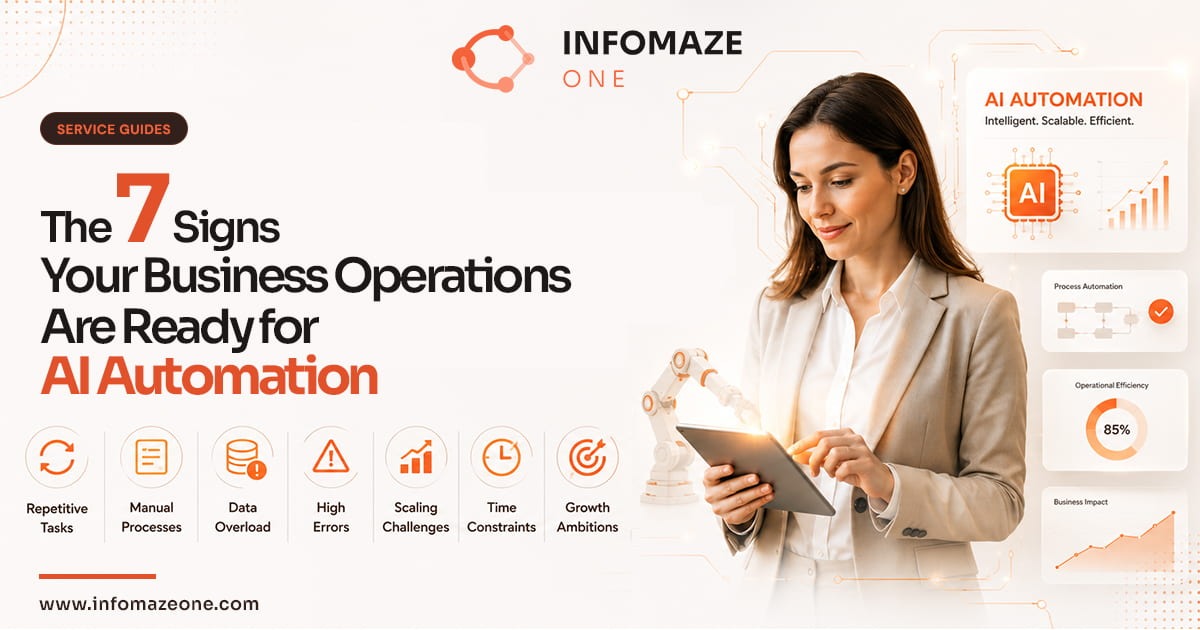
There’s no single metric that tells you it’s time. It’s usually a pattern – small inefficiencies that keep repeating across your team, your budget, and your customer relationships, until they’re too consistent to ignore. The seven signs below are the ones that show up most often, in roughly the order businesses tend to notice them.
Sign 1: Your team keeps drowning in repetitive manual tasks
Data entry. Invoice processing. Scheduling. Report formatting. When staff spend hours each week doing the same steps in the same order, every single time, that’s exactly the kind of work business process automation was built for. There’s no creativity required in copying a number from one system to another – just consistency, and machines are frankly better at that than a person who’s been staring at a screen.
Sign 2: The same errors keep slipping through, no matter how careful everyone is
Retraining the team doesn’t fix this. Adding a second review step doesn’t fix this either. If the same type of mistake – a wrong invoice figure, a duplicate customer record, a missed compliance date – keeps resurfacing month after month, the issue isn’t your people. It’s the process they’re stuck using. Automating business processes removes the human fatigue that causes these errors in the first place.
Sign 3: Costs are climbing faster than output
Here’s a quiet warning sign a lot of business owners miss: you’re hiring more people just to hold steady at the same output. That means your cost per task is going up, not down. AI-powered business automation tends to bend that curve the other way – existing teams can absorb more volume without a matching jump in headcount, which is usually the number that gets a CFO’s attention.
Sign 4: Customers are waiting longer than they used to
People expect fast replies now, whether it’s a support ticket, an order update, or a payroll question. When your team can’t keep up without staying late, that gap becomes visible to the people who matter most – your customers. Automated workflows and AI-driven response systems can absorb the routine volume, leaving your team free for the conversations that genuinely need a human on the other end.
Sign 5: Nobody fully trusts the numbers anymore
Sales has one version of a customer’s data. Finance has another. Operations has a third, updated two weeks ago. Meetings turn into arguments about whose spreadsheet is right instead of what to do next. This is often where AI automation for business earns its keep first – connecting systems and giving every department the same source of truth.
Sign 6: Growth feels harder than it should
Growth is supposed to build momentum. If every new client or product line demands a disproportionate amount of manual effort just to keep things running, your operations weren’t built to scale – they were built to survive at your current size. Automated workflows are meant to absorb volume increases without dragging in the same amount of extra friction and error.
Sign 7: Your strongest people are doing your most forgettable work
This one tends to get noticed last, though it might matter the most. If your sharpest employees are buried in spreadsheets and reconciliations instead of strategy or client relationships, that’s a resourcing problem, not a staffing problem. Business process automation frees them up to do the work only they can do.
What to Do When Your Business Is Ready for Automation
Spotting the signs is the easy part. Acting on them is where most companies stall – building an internal AI and automation function usually means new software, new training, and new hires that most businesses aren’t in a position to take on right now.
That’s usually where an outsourcing partner changes the equation. Rather than building automation capability from the ground up, more companies are handing off the operational load – data operations, admin support, accounts payable and receivable, HR and payroll, workflow automation – to teams already running on AI-powered systems day to day.
How Infomaze One Supports AI-Powered Business Automation
That’s the gap Infomaze One was built to close. Instead of asking a business to bolt automation onto processes that were never designed for it, Infomaze One pairs experienced back-office teams with AI-powered managed services, so the work gets faster and more accurate without anyone having to build an automation department from scratch. If your biggest headache is scattered records, inconsistent reporting, or files that never seem to be where they should be, Infomaze One is a genuinely strong place to start – outsourced data management is one of the things the whole setup is built around.
Final thoughts
If two or three of these signs sound familiar, your operations aren’t broken. They’ve just outgrown the way you’ve always run them, and that’s a normal stage for a business that’s actually growing. It’s also exactly the point where AI automation delivers the most value, because there’s real inefficiency for it to clear out.
Companies that act on these signs early free up their teams to do work that actually moves the business forward. The ones that wait usually end up automating anyway – just after a lot more avoidable friction along the way.
Ready to automate your operations?
Book a free AI Audit — 60 minutes, no obligation, realistic ROI estimate.