
A business manager opens the CRM dashboard in the morning and sees hundreds of new customer records waiting to be entered. Orders from the website need to be copied into the inventory system. Payment data needs to be transferred into accounting software. Marketing leads from spreadsheets must be uploaded into the email system.
Now imagine this happening every single day.
Did you know that companies lose nearly 20–30% of employee productivity every year due to repetitive administrative work, including manual data entry tasks? Even more concerning, industry studies show that nearly 1 in 5 manually entered records contain some form of error.
That raises an important question: If teams spend hours entering data instead of analyzing it, how can businesses scale efficiently?
Many organizations believe manual entry is harmless because it feels routine. However, over time it quietly creates delays, operational mistakes, and missed opportunities. The issue is not just about typing information into systems—it is about how that process affects decision making, workflow speed and customer experience.
Understanding the real impact of manual processes helps companies identify where growth slows down and what operational changes truly move the business forward.
Challenges of Manual Data Entry in Growing Organizations
The Hidden Operational Cost of Manual Data Entry
Data entry seems simple on the surface. A team member copies customer information from one platform into another system. An operations assistant transfers order details into accounting software. A marketing coordinator imports leads from spreadsheets into the CRM.
Each task takes only a few minutes. However, when multiplied across departments, the time loss becomes significant.
Consider a sales team that receives 600 new leads per week from various channels such as website forms, trade events and marketing campaigns. If each record requires just 2 minutes of manual processing, the team spends 20 hours every week only entering lead data. That equals half of an employee’s working time being used for administrative work rather than sales engagement.
Instead of hiring more internal staff to manage this workload, businesses are increasingly choosing data entry outsourcing, ensuring faster turnaround and freeing internal teams for revenue-generating activities.
The effect spreads across departments:
- Sales representatives wait for updated leads before contacting prospects.
- Marketing teams delay campaigns because customer data is incomplete.
- Finance departments reconcile mismatched invoice records.
- Inventory teams manually update stock numbers between systems.
Instead of accelerating growth, internal processes slowly create friction across the entire business structure.

Data Accuracy Issues That Damage Business Decisions
Data drives every major decision in modern organizations. Sales forecasts rely on CRM data. Marketing strategies depend on customer analytics. Financial planning requires precise transaction records.
When information enters systems manually, accuracy becomes unpredictable.
Human typing errors occur frequently when employees process large volumes of information. A single digit mistake in a phone number can prevent a sales call from happening. An incorrect product code may lead to shipping the wrong item to a customer.
These manual data entry errors do not always appear immediately. They often remain hidden until they create operational consequences.
For example, an e-commerce company managing thousands of orders may manually transfer purchase information from its website platform into the logistics system. If a product quantity is entered incorrectly, warehouse teams ship the wrong number of items. The mistake triggers customer complaints, product returns and additional shipping costs.
Outsourcing data entry services can reduce this risk significantly by introducing structured workflows, quality checks, and standardized processes.
Inaccurate data gradually damages three critical business areas:
- Customer trust
- Operational efficiency
- Financial forecasting
Reliable data is essential for scaling operations and manual processes make reliability difficult to maintain.
Delayed Operations That Slow Customer Response
Speed plays a major role in modern business success. Customers expect quick responses, fast order confirmations and immediate service updates.
Manual data entry workflows make speed difficult to maintain in modern business environments.
When teams rely on spreadsheets or internal documents to transfer information between systems, processes become dependent on human availability. If one employee delays updating records, the next department must wait.
Consider a logistics company that manages fleet operations and delivery tracking. If driver updates, delivery confirmations, or fuel usage reports are entered manually at the end of each day, managers cannot monitor real-time fleet performance. That delay prevents immediate operational adjustments.
Similarly, sales organizations often lose opportunities when leads are not processed quickly. Research shows that contacting a new lead within five minutes increases the chances of conversion dramatically. However, manual lead entry often delays that response by several hours or even days.
Operational delays accumulate silently and eventually they limit the company’s ability to compete in faster markets.
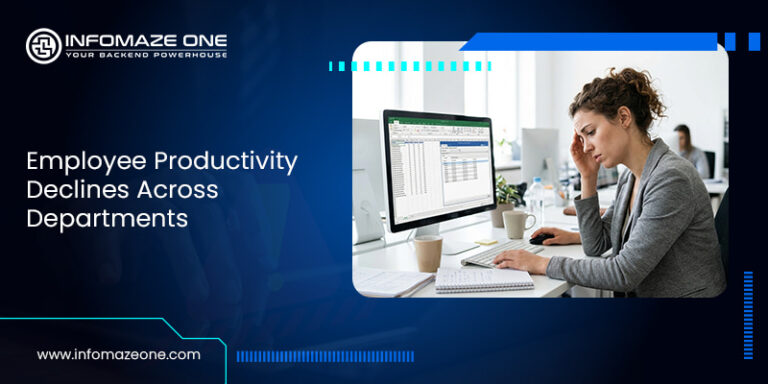
Employee Productivity Declines Across Departments
Highly skilled employees bring value through strategy, analysis and problem solving. However, repetitive administrative work slowly reduces the time available for those activities.
When business teams spend hours copying and pasting information between systems, productivity drops in ways that are not always visible in performance reports.
Sales representatives who should be focusing on client conversations instead organize spreadsheets. Marketing teams spend time formatting data files rather than analyzing campaign performance. Operations managers track inventory manually instead of optimizing supply chain processes.
The impact goes beyond time loss. Repetitive tasks also affect employee motivation.
Employees working with modern technology expect efficient systems that help them focus on meaningful work. When daily tasks involve routine typing and data formatting, job satisfaction gradually declines.
Organizations that prioritize operational efficiency recognize the importance of building systems that reduce manual data entry so teams can focus on higher value activities.
Data Silos That Break Business Visibility
Modern companies rely on multiple digital tools such as CRM platforms, accounting software, marketing automation systems and inventory management tools. Each system manages a different type of business information.
When data flows between these systems manually, information often becomes fragmented.
A marketing platform may contain updated customer emails, while the CRM still stores outdated contact records. Finance software may show completed transactions, but the operations system may not reflect the same updates.
Over time, this fragmentation creates data silos that limit visibility across departments.
Decision makers struggle to obtain a clear picture of business performance because information lives in different systems that are not synchronized. Reports require manual consolidation and inconsistencies appear between departments.
This is where data entry automation-driven integration platforms become important. Infomaze One bridges this gap by not only enabling system Integration-driven data management solutions to help bridge this gap by ensuring synchronization across systems.
For leadership teams, this lack of unified visibility becomes a serious growth barrier. Strategic decisions rely on complete and accurate information and manual data management makes that difficult to achieve.
Operational Scaling Becomes Difficult
Growth introduces complexity. As customer numbers increase, transaction volumes grow and operational workflows expand.
Manual processes struggle to handle that growth.
A startup processing 100 orders per week may manage manual entry without major issues. However, when the company grows to 2,000 orders per week, the same workflow becomes impossible to maintain.
Hiring more employees to perform repetitive administrative tasks may seem like a solution but it only increases operational costs without improving efficiency.
At this stage, companies begin evaluating manual data entry vs automation to understand how scalable systems operate.
Data entry automation platforms integrate different business tools and transfer information automatically between them. Instead of employees manually updating records, systems exchange data in real time.
This transition transforms operational capacity. Companies process higher volumes of transactions without increasing administrative workload.
Strategic Shift Toward Automated Data Workflows
Businesses that prioritize their operational efficiency start by analyzing where manual processes exist across departments. The most important goal is always to design workflows that allow systems to communicate directly.
Automated integrations between CRM platforms, accounting software, marketing tools and operational systems remove repetitive tasks from daily workflows.
When new leads enter the system, they automatically appear in the CRM. When customers complete purchases, order details immediately update inventory and financial records. And when marketing campaigns capture contact information, those records synchronize instantly across platforms.
This approach creates several advantages:
- Faster operational workflows
- Consistent data accuracy
- Real-time business insights
- Reduced administrative workload
Organizations that implement these systems build stronger foundations for growth because their processes remain efficient even as transaction volumes increase.
Conclusion
Manual data entry may seem manageable in the early stages of business, but as operations grow, it becomes a significant barrier to efficiency, accuracy, and scalability. Organizations that transition toward automated and integrated workflows gain faster insights, improved productivity, and better control over their operations. By reducing dependency on repetitive administrative tasks, businesses can focus more on strategic growth and innovation.
We at Infomaze One support businesses by managing these operational workloads through reliable back-office solutions that ensure information is handled accurately and efficiently.
By offloading repetitive data management and administrative tasks to specialized teams, organizations can keep their systems organized while allowing internal teams to focus on strategy, innovation, and revenue growth.